Aspecten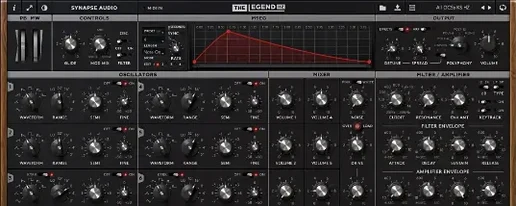
 Download (472 MB)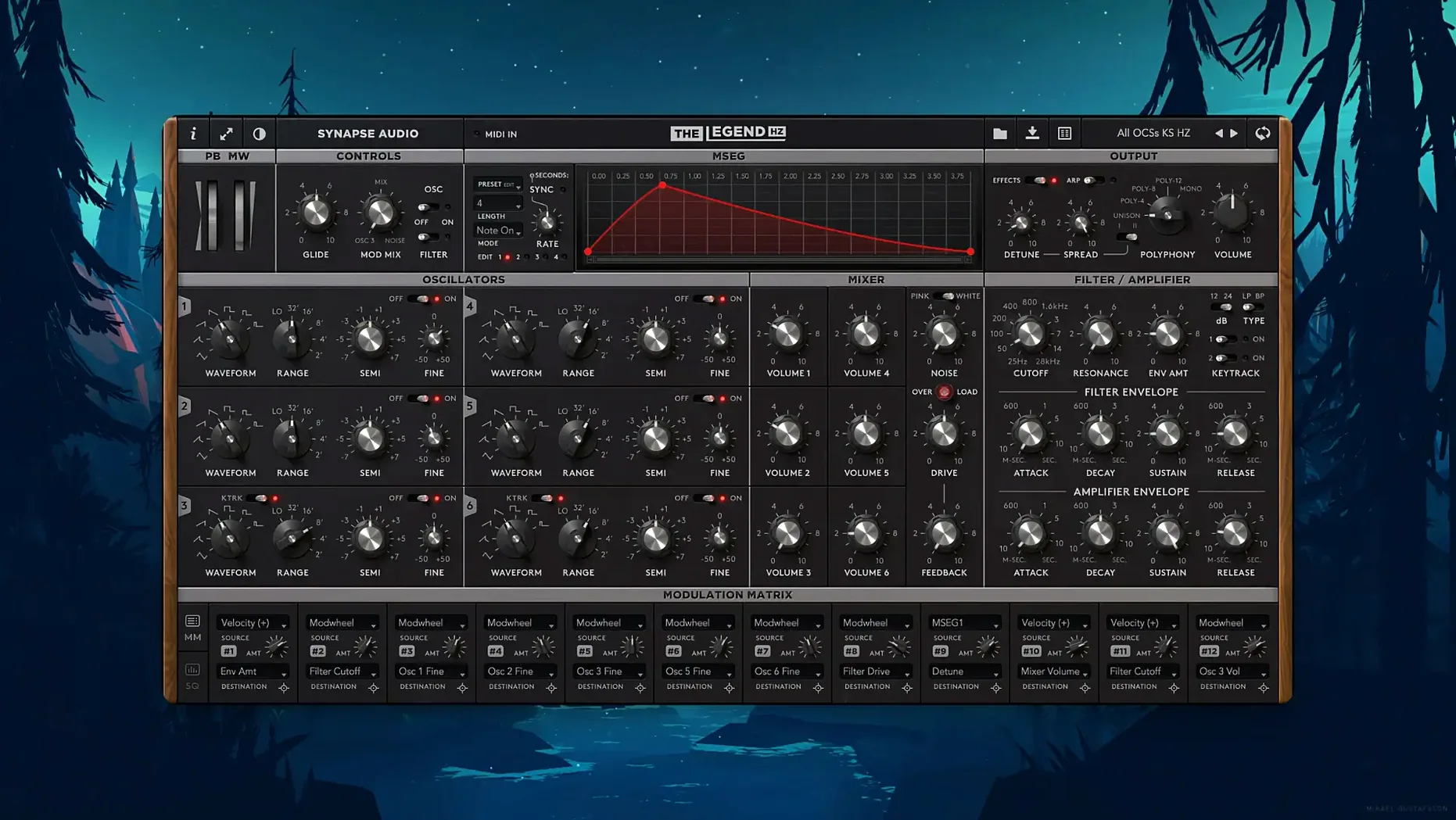
The paragraphic equalizer sits on the back panel, a recent addition that brings finer tone-shaping to the output stage. From the front, though, it still reads like a familiar analogue console — knobs, switches, signal flow laid out left to right.
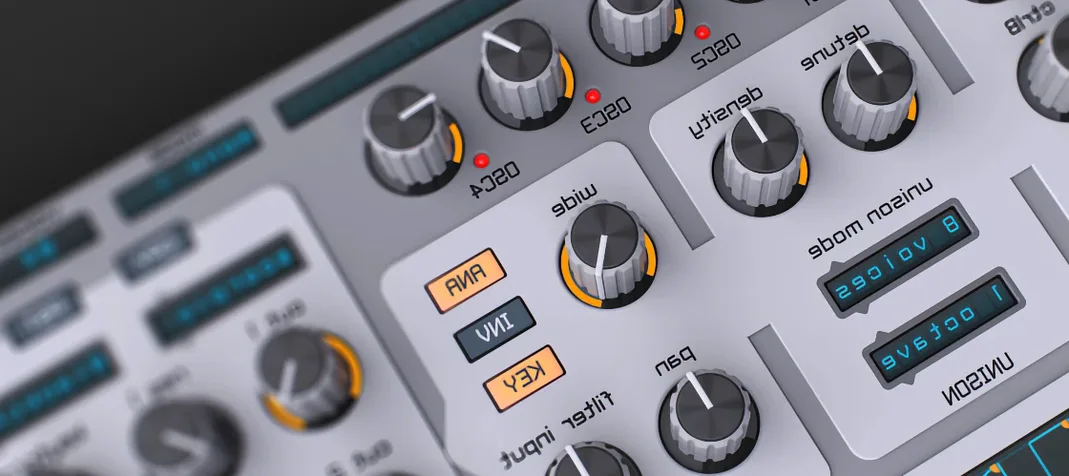
Host format — AU, VST3 and AAX plug-in; runs inside any DAW that supports one of those standards. Apple Silicon — native compatibility; no Rosetta required. macOS baseline — works from macOS 10.14 Mojave onward. Preset compatibility — patches and soundbanks created for the original Legend load directly into The Legend HZ. Interface language — English only.Six virtual-analogue oscillators sit where the original Legend had three, and they feed a signal path that includes a 914 Fixed Filter Bank. That module alone shifts the character beyond standard ladder-filter territory — narrow boosts and cuts across fixed frequency bands can hollow out a lead or push a bass patch forward in a dense arrangement. Unison mode stacks voices for thickness without needing extra instances, and MPE support means per-note pitch and pressure control from compatible controllers.
The factory bank holds 200 presets; Kevin Schroeder contributed an additional 50 in version 2.1. They lean into the extra oscillators and the filter bank rather than simply retreading familiar Moog-style territory. For anyone working with microtonal scales, the recent MTS-ESP tuning support keeps the synth in step with the rest of a microtuned project.
Building a cinematic bass pulse from scratch
Start with an empty patch — all oscillators off, filter wide open, envelopes at zero. Switch on oscillator one, set it to a sawtooth wave and tune it down an octave. Bring in oscillator two a fifth above, also a sawtooth, but drop its level slightly so it supports rather than competes. The beating between the two gives the low end a slow, organic movement.
Route both through the ladder filter. Set the cutoff to around 200 Hz, add a touch of emphasis, and assign an envelope with a medium-fast attack and a short decay — just enough to let the initial transient bite before the filter clamps down. Now switch on the 914 Fixed Filter Bank post-filter. Boost the 125 Hz and 250 Hz bands a couple of decibels, and cut the 500 Hz band by the same amount. The pulse tightens immediately, losing the hollow midrange that often plagues filtered saw basses.
Add oscillator three as a sine wave one octave below the root. Keep it quiet — barely audible in isolation, but it firms up the sub frequencies on systems that can reproduce them. For rhythmic interest, engage the arpeggiator. Set it to a sixteenth-note pattern, two octaves, ascending, and latch a single note. The pulse now moves like a modular sequence, but with the warmth of analogue modelling behind every step.
Switch to the back panel. The paragraphic equalizer lets you notch out a narrow band around 350 Hz where the arpeggiated notes start to overlap and build up. A 3 dB cut, Q set to around 4, cleans the low-mids without thinning the body. Engage the compressor with saturation engaged — drive the input gently until the needle nudges into the red on peaks. The saturation rounds off transients in a way that helps the pulse sit behind dialogue in a film cue, audible but not distracting.
Save the patch. The whole process takes under five minutes, and the result is a low-end element that works across tempo ranges from 80 to 140 bpm without choking the mix.
Dense orchestral placement with the 914 Fixed Filter Bank
Film composers working in dense orchestral templates benefit from the extra oscillators and the filter bank. They often need a synth bass or lead that cuts through strings and brass without overpowering them, and the 914 Fixed Filter Bank gives surgical control over which frequencies push forward. Hans Zimmer's involvement in the preset design means several patches already sit in a cinematic frequency pocket — dark, wide, and layered with subtle movement.
Sound designers who build patches from the ground up will find the six-oscillator architecture more flexible than the original Legend. Detuning three pairs of oscillators in stereo, then running them through the filter bank with different band emphases, yields pads that evolve over several bars without external modulation. MPE controller users — ROLI Seaboard, LinnStrument, Expressive E Osmose — get per-note expression that traditional mod-wheel setups cannot replicate.
Electronic producers who already own The Legend and a library of custom patches can load them straight into The Legend HZ and then extend them with the extra oscillator slots and the back-panel processing. The original synth still opens in projects that call for it, so nothing breaks. Keyboard players who prefer a hardware-like front-panel workflow over menu-diving will adapt quickly; every major control sits on a single screen, with the back panel reserved for less frequently adjusted parameters.
Paragraphic EQ cuts that replace a channel strip plug-in
The paragraphic equalizer on the back panel removed the need for a separate EQ plug-in on the channel strip. Narrow cuts at specific frequencies — something the fixed filter bank cannot do, since its bands are preset — are now handled inside the instrument. Producers who print stems with effects committed can shape the tone before it hits the audio track, which saves time during mixdown.
Compressor saturation, also added to the back panel, changed how presets respond at higher velocities. Pushing the input past a clean threshold introduces a soft clipping that glues unison patches together. Before version 2.1, thick unison stacks could sound slightly disconnected; the saturation stage adds a subtle cohesion that makes five-voice unison leads feel like a single instrument rather than a chorus of slightly detuned copies.
MTS-ESP microtuning support means the synth now follows the global tuning table set by other MTS-ESP-aware instruments. For composers working in just intonation or Arabic maqam scales, The Legend HZ stays in tune with the rest of the project without manual retuning. This was a gap in earlier versions that required workarounds involving pitch-bend or separate instances per scale degree.
The extra 50 presets by Kevin Schroeder expanded the factory bank to 250 patches total. Several of the new additions make direct use of the paragraphic EQ and compressor saturation, so they double as tutorials — loading one and checking the back panel reveals how the new modules interact with the core sound.
Separate plug-in, shared patches
Does it replace The Legend, or do I keep both? You keep both. The Legend HZ loads as a separate plug-in, so projects that use the original continue to open The Legend. Patches and soundbanks from the original load into The Legend HZ without conversion, but the reverse is not true — patches that use the extra oscillators or the filter bank will not sound correct in the original. The two can run side by side in the same session, which is useful for producers who want the lighter CPU footprint of the original for simpler parts and the expanded architecture for featured sounds.
How heavy is it on the CPU? A single instance playing a six-oscillator unison patch with the filter bank and back-panel processing engaged will use more resources than the original Legend, but it remains lighter than many wavetable or granular synths doing comparable polyphony. On Apple Silicon Macs, the native code keeps voice counts practical for real-time playing without freezing tracks. Older Intel machines running macOS 10.14 will feel the difference with unison and polyphony pushed to the maximum twelve voices.
Can I use it without a DAW? The Legend HZ runs as an AU, VST3, or AAX plug-in and requires host software. There is no standalone application. If you need a standalone version, the original Legend offers one, but The Legend HZ is plug-in only.
What does the 914 Fixed Filter Bank actually do that the ladder filter cannot? The ladder filter is a single resonant lowpass with a slope that sweeps continuously. The 914 is a set of fixed-frequency bands — like a graphic equaliser with preset centre frequencies — that boost or cut at narrow, non-adjustable points. Using both together lets you apply broad tonal shaping with the ladder filter and then emphasise or suppress specific frequency regions with the 914. It is a studio technique borrowed from vintage modular systems, now