Aspecten
 Download (46 MB)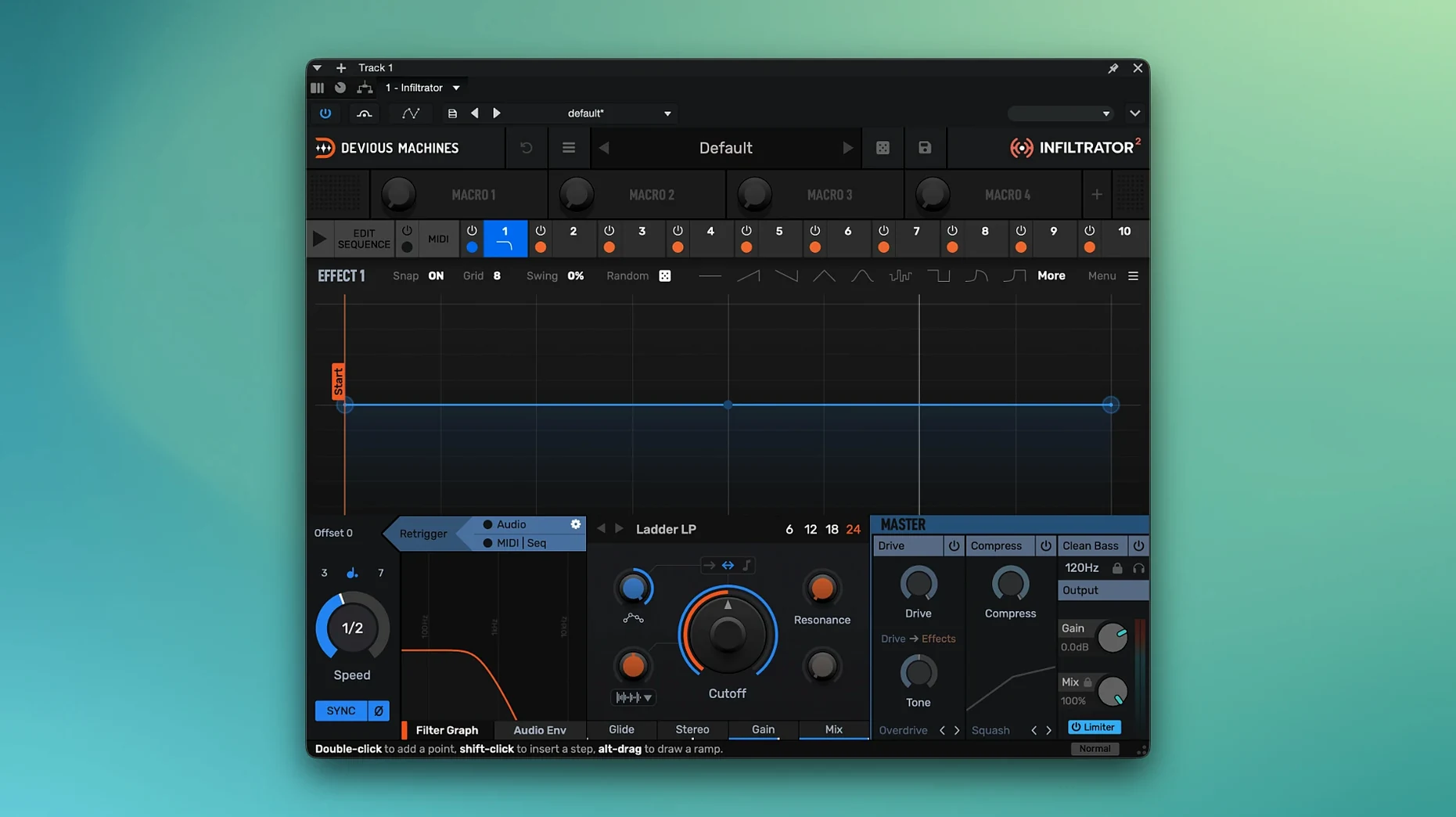
Stacking multiple effects in a DAW quickly leads to a tangle of sends, automation lanes and floating windows. Infiltrator 2.5 sidesteps that by keeping every effect, its sequence and its modulation inside one plug-in. The result is a signal chain that behaves less like a rack and more like a patchable instrument.
| What | Details |
|---|---|
| Type | Multi-effect processor |
| Architecture | 64-bit ARM and x86 |
| Mac support | OS X 10.11 onward |
| Interface | English |
In practice the plugin sits comfortably on individual tracks, where a 16-step sequencer drives effect parameters in time with the host. The same sequencer makes it useful on buses too, gating reverb tails or pushing a drum group through a rhythmic filter sweep. Version 2.5 adds an output limiter, which helps when aggressive resonance spikes the level, and custom beat divisions that let triplet or dotted rhythms lock to a project without manual calculations. The processing itself ranges from liquid analogue-style filtering to harder, reality-bending transformations, so a single instance can move from subtle chorus movement to a complete spectral chop without touching another insert.
The output limiter that arrived in 2.5
Version 2.5 introduced two additions that quietly shift how a session runs. The output limiter sits at the end of the chain and catches peaks that aggressive filter resonance or stacked saturation stages can produce. Before it arrived, a patch that sounded controlled at one sequencer step could spike four steps later, forcing the user to pull back the master output or insert a separate limiter afterwards. Now the ceiling is built in, so a sound can be pushed harder from within the plugin without the mix engineer flinching.
Custom beat divisions arrived in the same update. Tempo-synced effects previously worked with straight subdivisions, which left triplet and dotted rhythms to be approximated by ear or handled with a separate plugin. The new divisions mean a filter sweep or a tremolo can land precisely on a dotted eighth or a triplet quarter, locked to the host tempo. In genres where swung or shuffled movement matters, that removes a small but persistent friction point.
Version 2.5.26 itself is a maintenance build, listed as the current Mac download. The developer notes that it remains fully compatible with projects saved using the original Infiltrator, which matters for anyone reopening older sessions.
Animating a static pad from scratch
A producer opens a half-finished track and loads Infiltrator onto a synth pad that feels too static. The default patch appears with a single effect slot active and the sequencer idle. The first move is to pull up the effect browser and drop a comb filter into slot one, then a distortion unit into slot two. A third slot gets a stereo delay, and the routing between them stays serial for now.
With the sounds chosen, attention shifts to the 16-step sequencer at the bottom of the window. Each step can set its own value for any assigned parameter, so the first four steps are given rising filter cutoff values while the distortion drive stays low. Steps five through eight push the drive higher and open the delay mix. By step twelve the signal thins out as the filter closes and the delay feedback takes over. The tempo sync is set to a dotted eighth, a beat division that would have required workarounds before version 2.5.
Modulation comes next. An envelope follower is assigned to the comb filter resonance, so harder-hit notes open the resonance further. A slow LFO is routed to the delay time, creating a subtle pitch wobble in the repeats. The output limiter is engaged with a conservative threshold, catching the loudest peaks from the distortion stage without colouring the body of the sound. The whole patch is saved as a user preset and dropped onto a send channel for a second instance, where a different sequencer pattern gates a reverb return. Within twenty minutes the track has movement that would otherwise require five plugins and several automation lanes.
Comparisons with Similar Plugins
Three other Mac multi-effects invite comparison, though each approaches the task from a different angle.
Soundtoys Effect Rack bundles individual Soundtoys processors in a single window with a shared modulation system. The sound quality is high and the individual effects have character, but the sequencing side is less integrated. Infiltrator's 16-step sequencer treats every parameter as a per-step target, whereas Effect Rack leans more on LFOs, envelopes and rhythm-based modulation shapes. A user who wants step-sequenced filter patterns will find Infiltrator more direct; someone who prefers analogue-style saturation and ensemble effects might gravitate toward the Soundtoys palette.
Glitchmachines Cataract shares the step-sequenced multi-effect concept but with a narrower, more aggressive sonic identity. It sequences four effects and excels at digital destruction and stutter-based textures. Infiltrator's broader effect count and its ability to shift from liquid filtering to spectral chopping give it a wider dynamic range. Cataract suits short, chaotic bursts; Infiltrator handles those but also stays useful on a vocal bus or a master chain where subtlety matters.
Kilohearts Snap Heap offers modular multi-effect construction with drag-and-drop routing and a clean interface. Its modulation system is flexible but lacks a built-in step sequencer of Infiltrator's depth. A producer who already works with Kilohearts' ecosystem might prefer Snap Heap for consistency, while someone building rhythmic effect patches from scratch will find Infiltrator's sequencer the faster starting point. The two can coexist on the same machine without overlap.
Copy-paste whole effects with their modulation
Right-clicking an effect slot opens a context menu that lets the user copy or paste an entire effect with its modulation assignments intact. Dragging an effect to a new slot reorders the chain without losing its sequencer ties. Holding Shift while adjusting a sequencer step snaps the value to finer increments, which matters when a parameter like filter cutoff needs a precise frequency rather than a rough sweep.
The sequencer lane height is resizable by dragging its top edge. On a smaller laptop screen this keeps the effect slots visible while still showing enough steps to be useful. Double-clicking a step resets it to its default value, which is faster than dragging it back manually.
When a project uses tempo changes, Infiltrator's beat divisions follow the host timeline without drifting. The output limiter includes a gain reduction meter that is small enough to ignore but present when needed, tucked into the master output section. And if a patch uses only three of the ten available effect slots, the unused ones draw no CPU cycles, so a light instance on a dozen tracks does not punish the system.
A user who often reaches for the same starting chain can save an effect rack as a default preset, then load it with one click from the browser. The plugin also recalls its last state when re-opened, which makes A/B comparisons across sessions less fiddly than rebuilding a patch from memory. Those who explore the darker end of sound design will find that an Infiltrator VST crack search occasionally turns up modified builds, and the 2.5.26 release carries the limiter, the custom beat divisions and the project compatibility that make daily use reliable.