Aspecten
 Download (128 MB)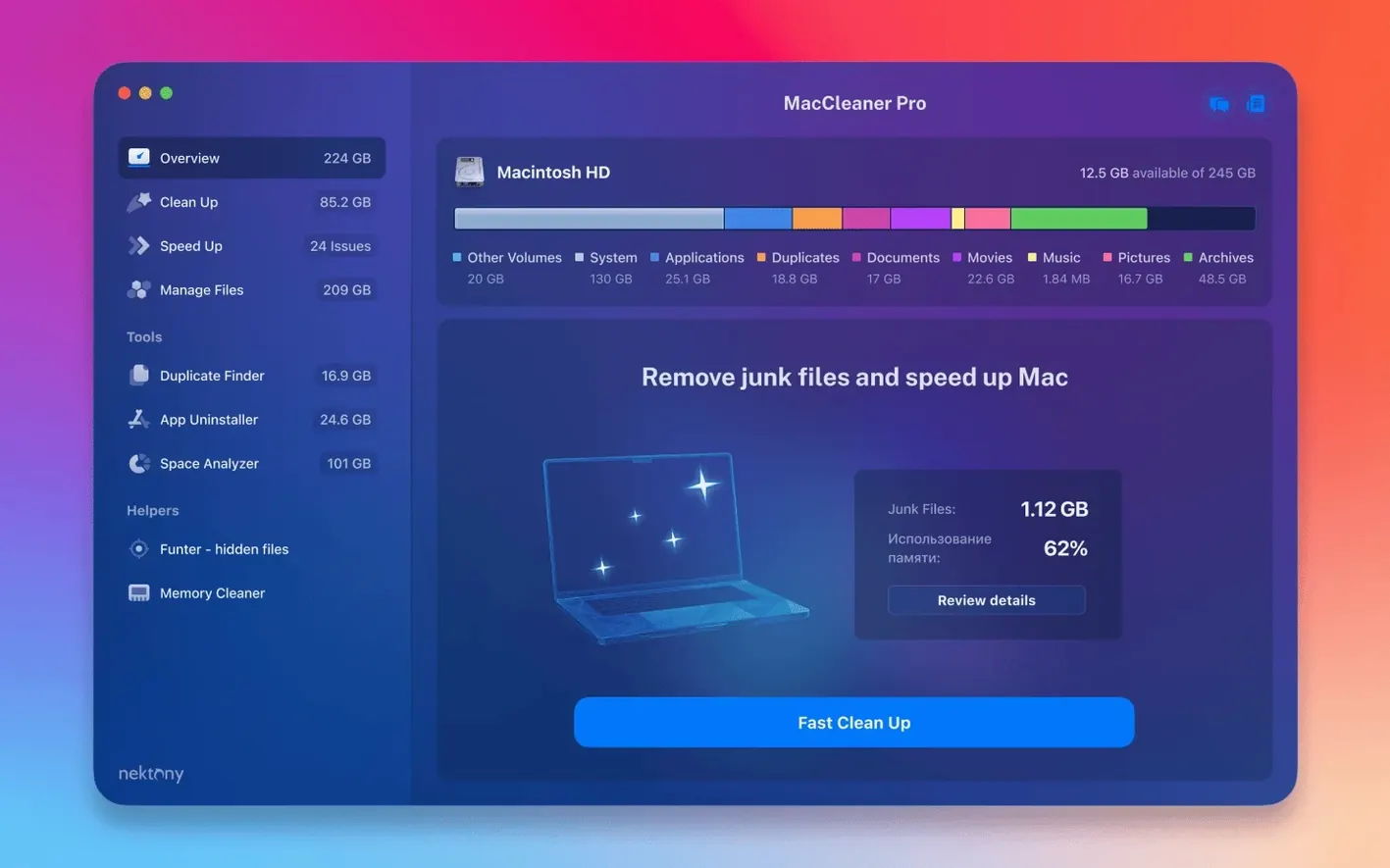
MacCleaner Pro is a six-tool bundle from Nektony that combines app removal, disk analysis, duplicate finding, memory cleaning, and hidden-file access for macOS 10.13 and later. The bundle ships as a single package containing MacCleaner Pro 4.0.2, App Cleaner & Uninstaller 9.0.3, Disk Space Analyzer 6.0, Duplicate File Finder 8.5.2, Funter 7.1, and Memory Cleaner 5.5.
People searching for a maccleaner pro cracked installer often ask whether all six tools activate together and whether the bundle phones home. The package activates with instructions included in the installer — there is no separate step per tool — and the interface runs entirely in English. If you're using a MacCleaner Pro torrent, check that all six modules appear under the main dashboard and that the scan engine completes a full pass without hanging. Nektony describes the suite as a way to prevent the Startup Disk Full error by targeting leftovers, large files, duplicates, and unused applications in one pass.
Version 4.0.2 tightened detection of items stored in an iCloud folder and inside a custom Home folder, along with a handful of minor interface fixes. Those changes matter if you keep large media libraries in cloud-synced locations, because earlier versions could miss them during a scan.
Beyond the core cleanup, the bundle includes App Cleaner & Uninstaller PRO for removing leftover files and managing launch agents and system extensions. Duplicate File Finder and Disk Space Analyzer give you a visual map of storage, while Funter reveals hidden files without a terminal command. Memory Cleaner rounds out the set with a lightweight RAM purge that runs from the menu bar.
Switch leftover scanning to Thorough to catch more files
After installing the bundle, a few preferences tweak how each tool behaves. In App Cleaner & Uninstaller, switch the leftover file scanning from the default Safe level to Thorough. Safe mode stops at the usual Library folders; Thorough digs into caches, containers and group containers that can hold gigabytes of orphaned data from removed applications. The trade-off is a slightly longer scan, but the difference on a machine that has seen dozens of app installs and removals is often measurable in tens of gigabytes reclaimed.
In Duplicate File Finder, enable the option to compare file content rather than just name and size. Name-and-size is quick and catches obvious copies, but content comparison identifies files renamed after downloading, such as images saved twice under different filenames or audio files pulled from different sources. Also set the minimum file size filter to something sensible — 100 KB works for most users — otherwise you will wade through thousands of tiny preference plists and cache entries that duplicate legitimately across app containers.
Memory Cleaner lives in the menu bar by default and polls RAM usage every few seconds. If you find the constant polling distracting, increase the refresh interval in its preferences. The clean action remains available on demand regardless of the polling rate. Also check the “Launch at login” setting across all six tools: only Memory Cleaner and Funter benefit from running at startup; the other four launch quickly enough when needed and do not need to sit in the background.
What a freelance designer does with it
Consider a freelance brand designer who works across Illustrator, Photoshop, InDesign and Figma, switching between client projects with distinct font sets, asset libraries and exported preview files. Over six months her 512 GB SSD creeps from 80 GB free to less than 15 GB. The low-space warning appears during a client presentation.
She opens Disk Space Analyzer first. The sunburst chart shows a single fat segment: a folder of exported PDF proofs inside a client project directory, each file 120–180 MB, some dating back to drafts from two years earlier. She selects the folder in the file list and moves the oldest revisions to an external archive drive directly from the interface. Next she runs Duplicate File Finder on her entire Assets folder. It surfaces 47 copies of the same stock photo, saved under different project names. She deletes all but one and notes where the original lives. Finally, App Cleaner & Uninstaller reveals leftover folders from three design-tool betas she uninstalled months ago. The combined pass frees 63 GB. The startup disk warning does not return for the rest of the project cycle.
Compulsive memory purging slows your Mac for seconds
The most common misstep is treating Memory Cleaner as a performance booster and clicking it compulsively. Purging inactive RAM forces macOS to reload data from disk into memory again, which can make the machine feel slower for a few seconds after each purge. The tool is useful before launching a memory-hungry application or when the system becomes genuinely sluggish under swap pressure, but using it as a routine “clean my Mac” button achieves the opposite of what most people expect.
Another frequent error: scanning the entire disk with Duplicate File Finder and deleting duplicates from system directories. The tool prompts before deletion, but a beginner who sees two copies of a file inside /System/Library/ or an application bundle might assume they are safe to remove. They are not — macOS and many apps store intentionally duplicated files for version fallback, code-signing integrity and sandboxed containers. Restrict duplicate scans to ~/Documents, ~/Downloads, ~/Desktop and any external media folders. Leave system and app-bundle locations unchecked.
With App Cleaner & Uninstaller, beginners sometimes remove all detected leftovers without reading the file paths. Some files are shared preference containers used by multiple applications from the same developer. Removing a leftover labelled “Adobe” could strip licence files needed by Creative Cloud apps still installed. The safe habit: review the file list, expand each path, and uncheck anything that references a developer whose other apps you intend to keep.
Workflow: freeing space before a system update
A macOS point update requires enough free space to download the installer, expand it, and stage the installation files — often 25 GB or more. The following sequence clears space methodically without guessing which files are safe to remove.
Step 1: Open Disk Space Analyzer and scan the startup volume. Sort the result list by size descending. Look for folders inside ~/Library/Caches, ~/Library/Logs and ~/Library/Application Support that belong to apps you no longer use. Also check ~/Downloads and ~/Movies — video files and DMG installers accumulate there and are easy to overlook.
Step 2: Note any folder you do not recognise. Search the folder name online before touching it. Disk Space Analyzer lets you reveal items in Finder, so you can inspect contents before deleting anything. Delete only folders you can confidently identify as safe — old application caches, obsolete project exports, downloaded disk images you have already installed.
Step 3: Switch to Duplicate File Finder. Target ~/Documents and ~/Desktop with content comparison enabled and a minimum size of 1 MB. Sort results by total wasted space. Delete copies where you have a verified original elsewhere, but resist the urge to clean out everything in one pass; keep the session focused on large media files and archived work folders.
Step 4: Open App Cleaner & Uninstaller. Switch to the Extensions tab and disable launch agents and login items for applications you rarely use. These do not consume much disk space, but they free memory and CPU cycles, which matters if the update will run on a machine with 8 GB of RAM.
Step 5: Run Memory Cleaner once, then immediately launch the system update. The purge gives the updater the largest possible contiguous memory pool for the installation process. After the update completes and the machine restarts, open MacCleaner Pro again and run a quick scan with each tool to catch any leftover installation temporary files that the updater did not remove.
The installer delivers every tool at once
A common thread in forums where people look for a mac cleaner torrent is whether the six tools can be installed separately or if the bundle forces all of them onto the machine at once. The installer delivers every tool together, and they appear as individual applications in the Applications folder. You can drag any of them to the Trash independently if you only need, say, App Cleaner & Uninstaller and Disk Space Analyzer. The remaining tools continue to function without complaint. There is no parent launcher that checks for the presence of all six.
Another question concerns whether the tools write launch daemons or background agents that persist after quitting the apps. Only Memory Cleaner installs a lightweight helper that sits in the menu bar; the helper stops entirely when you quit the application or disable the login item. The other five tools run as standard applications and leave no background processes. Some users searching for macleaner pro cracked downloads worry about hidden telemetry — the bundle does not require network access for any core function, and blocking it with a firewall does not affect scans, deletions or memory purges.
People also ask how the duplicate finder differs from the built-in Smart Folders in Finder, and whether the disk analyzer duplicates what the Storage tab in About This Mac already shows. The Finder cannot compare file content across directories, and Smart Folders cannot identify duplicates by cryptographic hash. Disk Space Analyzer differs from the system Storage overview in one important way: it shows a drillable file tree down to individual files, whereas the system panel groups data into broad categories like “Documents” and “System Data” that obscure what is actually taking up space.
A final practical concern: does the bundle handle external drives and network volumes? Disk Space Analyzer and Duplicate File Finder both scan any mounted volume, including USB drives, SD cards and NAS shares that appear in the Finder sidebar. App Cleaner & Uninstaller works only on the boot volume — it looks for leftovers in the standard macOS Library paths, which do not exist on external media. This limitation is worth knowing if you keep applications on an external SSD and expect the uninstaller to track their support files.