Aspecten
 Download (256 MB)
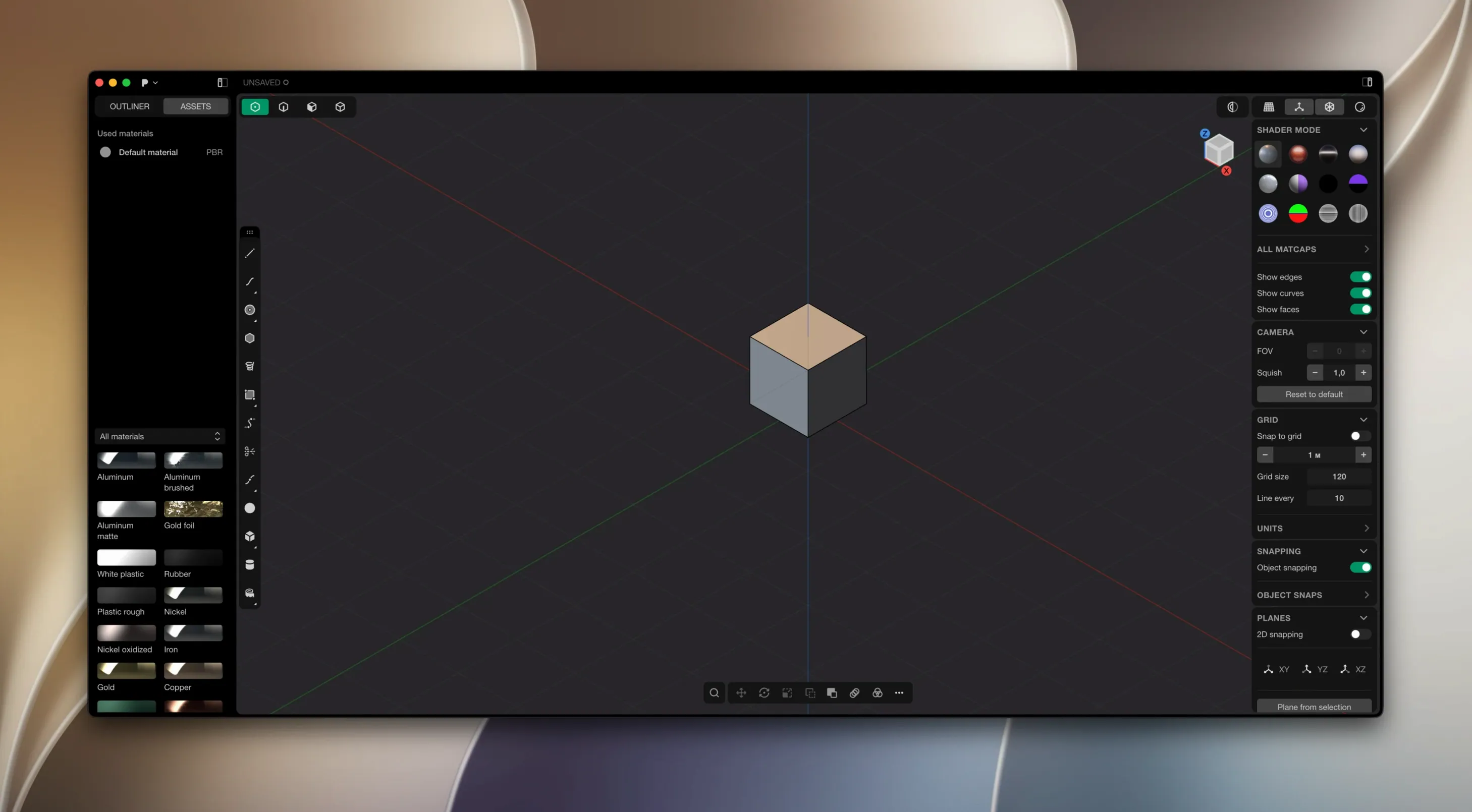
You pull a face on a curved form, and the adjacent surfaces ripple with a soft, machine-perfect swale. The radius value sits up in the viewport and you drag it, watching the blend shift in real time. Plasticity is 3D modelling software built for solids and surfaces, where aspects like XNURBS blending produce G2-continuous transitions without intermediate construction geometry.
Live dimensions that update geometry on the fly
- Industrial designers and concept modellers who switch between hard-edge solids and freeform surfaces.
- Workflows that benefit from live dimensions — alter a number and the geometry updates immediately.
- Exporting clean technical linework: the app can output hidden-line SVG drawings.
- Studio-licence users who need PolySplines for complex curves.
Patch tools rely on a desktop Patcher folder
- Updates are not automatic; each new release must be downloaded and installed manually.
- Patch tools may behave unexpectedly unless the Patcher folder is placed on the desktop.
The first days after installing
Spend the first hour with a simple test object — a casing, a bracket, something you know by heart in another modeller. The impulse is to jump straight into a production file, but Plasticity rewards a short calibration period where you learn how the direct-editing paradigm meets your own modelling habits.
One practical move on day one: set your chamfer and fillet defaults early. The live-dimension system pulls its initial values from the last operation you performed, so if you fillet a corner at 2 mm and then move to a different part of the model, the tool remembers that radius. Typing a fresh value overrides it, but knowing the behaviour saves you from wondering why a blend came in larger than expected.
If the patch tool gives trouble, drag the whole Patcher folder to the desktop and run it from there. The activation instructions in the package cover this, but it is worth doing proactively rather than waiting for a hiccup. After activation, the Patcher folder can be archived or removed.
Bookmark the boolean tolerance expectations. Plasticity uses the Parasolid kernel, which produces watertight results from union, subtract and intersect operations under normal circumstances, but stacking many booleans on a single body without periodic checks can surface edge-case geometry. A quick test boolean on a duplicate body tells you whether your modelling scale sits comfortably inside the kernel's precision range.
Another small habit: assign the radial-menu shortcuts to the tools you reach for most often. The default layout covers the essentials, but an industrial designer modelling enclosures will want a different top row than a character-hard-surface artist. The customisation panel takes two minutes and the muscle memory pays off within a week.
Switching between solid parts and organic skins in one file
Industrial designers working on consumer products, furniture, or handheld devices tend to find the sweet spot quickly. They model solids for structural parts and surfaces for organic skins, often in the same file. Plasticity handles that crossover without the heavy history tree that rebuilds every time you tweak a curve three weeks back in the timeline.
Engineers who need to produce concept geometry for downstream CAD also benefit. The direct-editing approach means a model can be rough-blocked, dimensioned, and exported as a STEP or IGES file in a short session. It does not replace a full parametric modeller for manufacturing documentation, but it fills the upstream gap where speed and surface quality matter more than feature-tree discipline.
Hard-surface 3D artists exploring a Plasticity torrent for the first time often stay for the XNURBS blending. A G2-continuous blend between two slabby mechanical forms is the sort of thing that takes considerable effort in a polygon modeller and here is a single operation. Artists who deliver render-ready assets for product visualisation gain a tool that slots neatly between concept sketches and final scene assembly.
Studio-licence users working with PolySplines and expanded CAD translation get the most complete feature set. If your work involves sending files between Plasticity and a dedicated engineering package, the Studio-tier translators reduce rework at the receiving end. Users exploring a plasticity 26.1.3 build for the first time on Apple Silicon hardware will notice the kernel works at native speed, which matters when a fillet chain is recalculating across dozens of edges simultaneously.
Rough sketch to extruded lump on the desk
You open Plasticity with a rough sketch on the desk beside the keyboard — a handheld measuring device, vaguely oval, with a grip valley on each side. The session starts with a simple extruded block, oversized, a lump of digital clay. You are not building a feature tree; you are carving and adding.
First, a boolean subtract to hollow the body shell. The Parasolid kernel produces a clean cavity in one operation, no patchwork. You drag the wall thickness with a live dimension and watch the section update. The dimension label sits in the viewport, white text on a dark background, ready to be retyped if the drag does not land on a round number.
Next, a series of fillets along the outer edges. A 4 mm radius on the top perimeter, 1.5 mm on the bottom lip, and a variable blend where the grip valley transitions into the main body. The variable fillet is where the XNURBS surface blending shows its value — the surface flows without a crease, G2-continuous, and the highlight rolls evenly as you tumble the viewport.
Mid-session, you realise the device length is wrong. In a history-based modeller this would be a careful edit of an early sketch. Here you grab the end face, push it outward by 12 mm, and the fillets and shell rebuild on the spot. The live dimensions attached to that face update, and the boolean shell thickens proportionally because the cavity was a subtract from the parent solid, not a separate feature.
You then split a curved surface near the thumb rest and apply a slight emboss via an offset face operation. The SVG hidden-line export proves useful later in the session: you output a clean technical line drawing of the top view, open it in a vector editor, and annotate dimensions for a quick design review. The whole session — from solid block to a rendered model with an exported line sheet — runs under ninety minutes.
macOS 10.14 on Apple Silicon is the floor
Will this run on my older Mac? The requirement is macOS 10.14 or newer on Apple Silicon. Users on Intel hardware or earlier versions of macOS will not be able to run the current build. Anyone searching for a Plasticity Mac crack should confirm their system uses Apple Silicon, since the native architecture requirement means no Rosetta translation path is available — it expects ARM instructions at the kernel level.
How does it compare to a traditional CAD package? Plasticity is a direct modeller, not a parametric history-based system. You gain speed and surface quality, particularly with XNURBS blends, but you lose the ability to double-click a feature from three hours ago and change a sketch constraint. The two approaches complement each other, and many users model concept geometry here before moving to a parametric environment for production documentation.
Is the learning curve steep? If you have used any solid-and-surface modeller before — Rhino, SolidWorks, Fusion — the transition is measured in days, not weeks. The direct-editing paradigm is simpler than a parametric workflow in many respects, though it asks for a different kind of planning. Newcomers to CAD-style modelling will need practice with the core concepts of solid bodies, surface patches, and boolean operations before Plasticity feels natural.
What about file compatibility? The Studio licence covers expanded CAD translation, including STEP, IGES, and other standard exchange formats. For users who find a Plasticity 3D torrent and want to test the import-export pipeline, the core formats are reliable provided the source geometry is reasonably clean. Parasolid-based boolean operations mean exported solids tend to arrive in other packages as watertight bodies, which saves repair time downstream.