Aspecten
 Download (46 MB)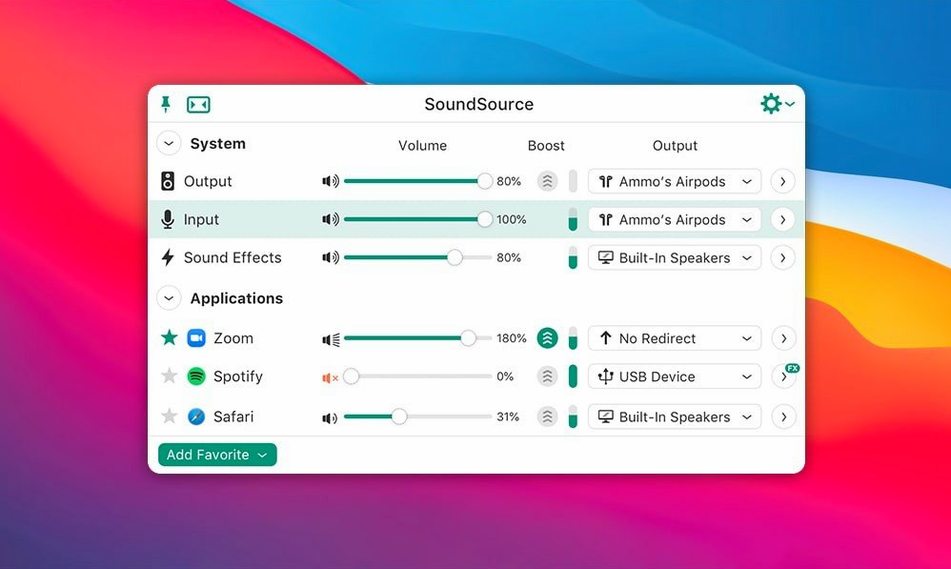
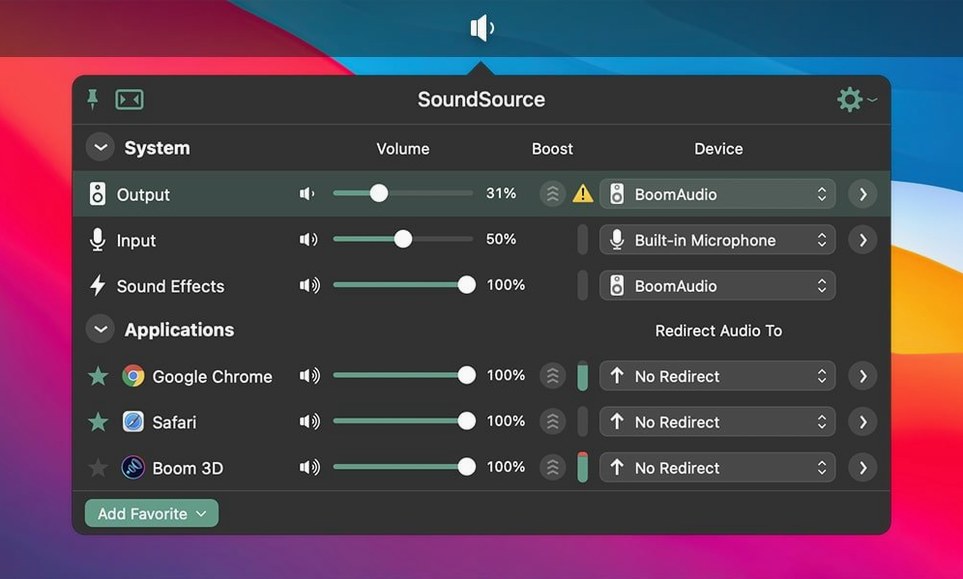
Musicians, podcasters, and anyone who regularly switches between headsets, speakers and microphones on a Mac tends to reach for SoundSource. It lives in the menu bar and puts input, output and per-app volume controls within two clicks, which saves a trip through System Settings.
One panel for input, output and effects routing
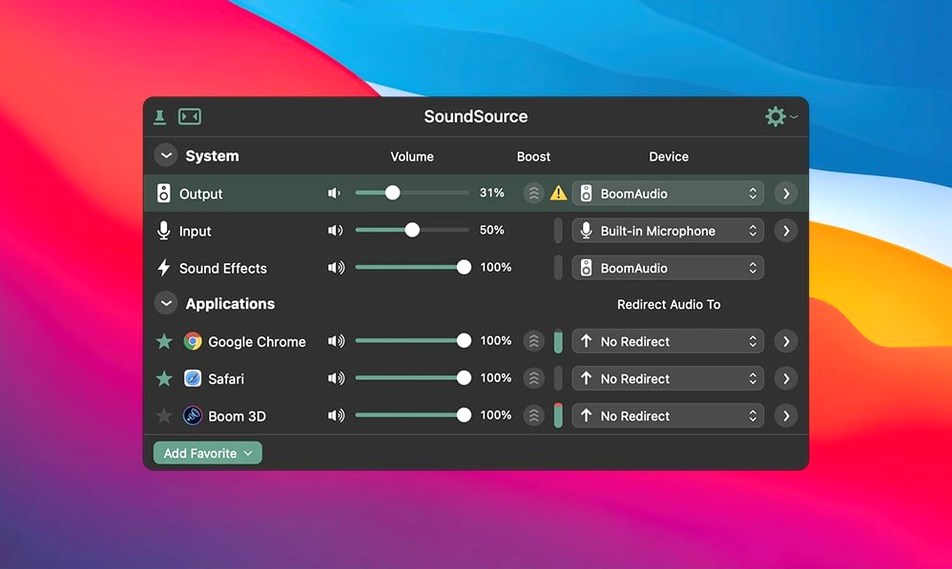
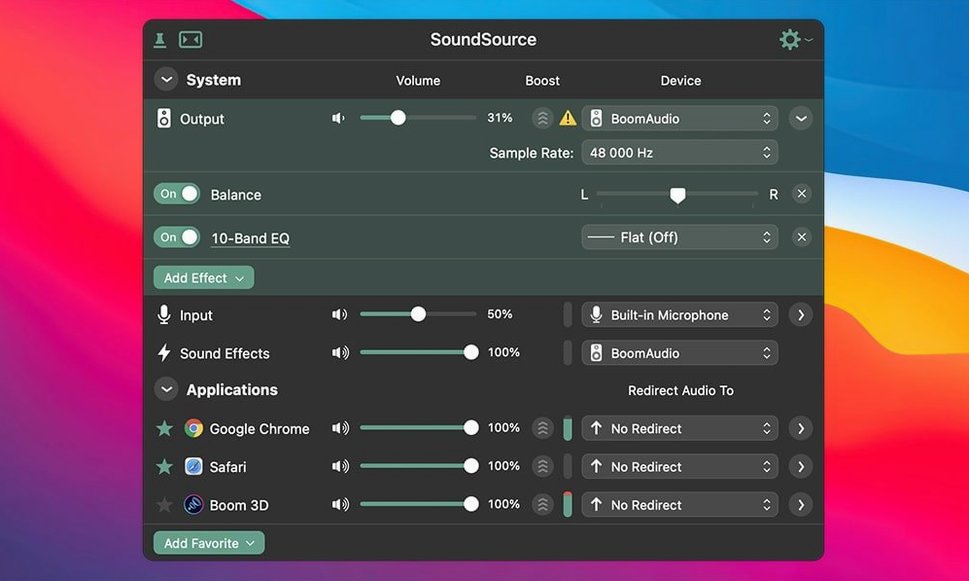
SoundSource gives you a single panel for choosing which device handles input, output and sound effects. You can set your microphone to a USB interface and your alerts to the built-in speakers, all from the same window. Per-app volume is part of the package too: you might lower Safari's level while keeping Music at full output. It also supports AirPlay streaming, so routing audio to a HomePod or an Apple TV is straightforward. If you have a layout you use often — say, a podcasting setup with a specific input and output pair — you can save the whole configuration and recall it with one click.
What do people worry about before installing?
A common concern is whether the current version works smoothly with Bluetooth gear. Version 6.1.4, released in September 2026, addressed exactly that: it fixed Bluetooth output performance issues and a related crash on macOS 27. Another practical question is about system requirements — it needs macOS 15 or later and runs natively on both Intel and Apple Silicon Macs. The interface is in English only. Installation involves mounting a disk image and using a Terminal command to bypass Gatekeeper, which is Rogue Amoeba's standard procedure and not something that should alarm you if you follow the steps.
Workflow: switching between a podcast setup and everyday listening
Suppose you record a weekly show with a USB microphone and monitor through wired headphones, but the rest of the time you listen via a Bluetooth speaker. Without SoundSource you would open System Settings, change the output, change the input, adjust the alert device and then repeat the process in reverse when recording time arrives. With a saved configuration, it shrinks to a single click.
First, set up your recording arrangement: plug in the microphone and headphones, open the SoundSource menu and select the microphone as the input device, the headphones as the output and the headphones again for sound effects (you do not want alert pings bleeding into your recording). Adjust the headphone volume slider and, if you use a VoIP app for remote guests, set that app's output and input inside the per-app section. Once everything sounds right, go to the Saved Configurations menu, choose Save Configuration and name it something like "Podcast setup".
Now switch to your everyday layout: select the Bluetooth speaker for output, the Mac's built-in speakers for sound effects and leave the input on the built-in microphone. Save this as "Daily listening". From now on, you toggle between the two from the menu bar in under a second, and every volume level and device assignment snaps back to where you left it. If you share the Mac with someone else, a third configuration for their preferences keeps things tidy.
System-level routing while a DAW claims the device
SoundSource does not replace an audio mixer; it works alongside one. When you use a DAW such as Logic Pro or an editor like Audacity, the DAW typically claims the audio device directly. SoundSource still handles system-level routing — alerts, background music, browser tabs — so you can lower Safari's volume while the DAW runs undisturbed through your interface. It also coexists with Rogue Amoeba's own Audio Hijack: Audio Hijack captures and processes, SoundSource routes and adjusts, and the two apps share the same ARK plugin under the hood (updated to version 13.5.4 in this release).
macOS features like AirPlay fit naturally. Click the output device menu and pick an AirPlay destination — a HomePod, an Apple TV — and the Mac streams system audio there while keeping alert sounds local, if you set the sound effects device separately. The menu bar placement means it sits next to Control Centre, so you can adjust Wi‑Fi and audio from the same strip of screen. For users who rely on the Touch Bar, SoundSource does not add anything there, but its menu bar panel is compact enough that it does not feel like a loss.
Output Groups deserve a mention here. You can select multiple outputs — say, wired headphones and a Bluetooth speaker — and SoundSource will send the same audio to both. Latency differs between wired and wireless, so the two streams will not be perfectly synchronised, but for casual listening across rooms it works without extra hardware. This is a macOS-level feature that SoundSource exposes, not a third-party workaround, which means it survives system updates better than most audio hacks.
Global output versus per-app output confusion
The most frequent slip is misunderstanding the difference between the main output device and the per-app output. A new user sets the global output to their headphones, then wonders why Music still plays from the built-in speakers. The answer is usually that Music had its own output assigned inside the per-app section, overriding the global choice. Checking the per-app list — especially after importing someone else's configuration — avoids ten minutes of confused cable-checking.
Another mistake: forgetting that sound effects have their own device setting. After switching the output to a Bluetooth speaker, alert sounds may still come from the Mac's internal speakers because the sound effects device never changed. The panel shows all three — input, output and sound effects — but newcomers often scan straight to the output slider and ignore the rest. Setting the sound effects device to "Same as Output" in the preferences prevents this, though it is not the default.
A subtler error involves volume mapping. SoundSource can show volume as a percentage or as a decibel scale, and toggling between them changes where zero sits. Someone who switches to the dB view and sees a negative number may think the volume is muted and crank it up, only to get a loud surprise when the next track starts. The dB scale reads attenuation from full output, so -20 dB is still quite audible. Sticking with the percentage view until you are comfortable avoids this.
Bluetooth buffer-size crashes fixed after macOS 27
The two Bluetooth fixes in version 6.1.4 address problems that had been nagging at users since macOS 27 shipped. Before the update, some Bluetooth devices would refuse to honour the buffer size SoundSource requested, which could trigger a crash when switching outputs or waking the Mac from sleep. The crash was not universal — it depended on the specific Bluetooth chipset — but when it happened, it was reproducible and disruptive. The fix means you can now leave a Bluetooth speaker selected overnight without finding a crash report in the morning.
The Bluetooth output performance fix is harder to describe but obvious in daily use. On affected devices, audio would stutter or drift out of sync by a fraction of a second after an hour or two of playback. Stopping and restarting the audio stream cleared it temporarily. Version 6.1.4 eliminates the root cause, so long listening sessions — a full album, a film, a day of background music while working — stay clean. Users who had learned to reselect their output device every ninety minutes can drop that habit.
The ARK plugin update to 13.5.4 is less visible but underpins both fixes. ARK handles the low-level audio capture and device communication for all current Rogue Amoeba apps, so improvements here benefit the whole suite. For SoundSource alone, the practical effect is a quieter crash log and a more predictable relationship with Bluetooth hardware. No new buttons, no changed workflows — just fewer interruptions.