Aspecten
 Download (38 MB)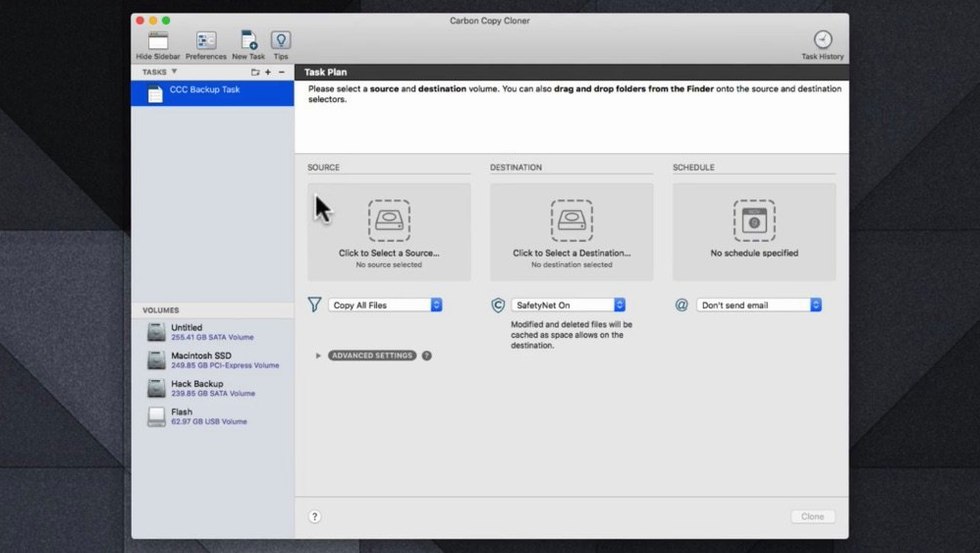
Drops Catalina, Big Sur, and Monterey to require macOS Golden Gate or newer
CCC 7 requires macOS 10.15 Catalina or newer and runs natively on Intel and Apple Silicon Macs via a Universal application build. Bombich Software removed support for Catalina, Big Sur, and Monterey in version 7, so the app is fully qualified on macOS Golden Gate and later releases. The interface is presented in English.
A scheduled backup workflow
- Open CCC and choose a source disk or a set of folders to back up.
- Select a destination volume.
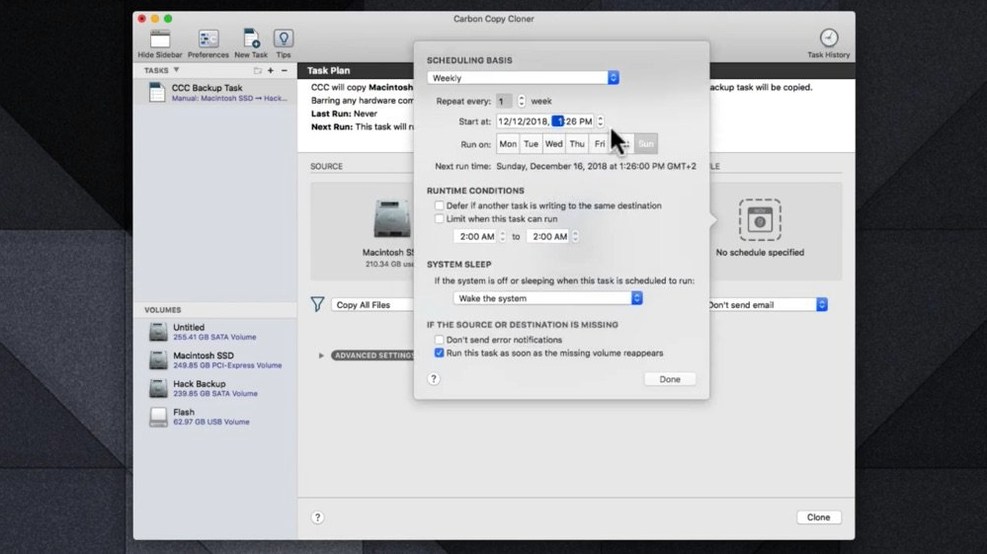
- Set the task to run on a chosen day of the week and time, then save the schedule.
- Leave CCC in the background; it copies files at the appointed time without further input.
CCC 7 works as a backup and file copying utility that sits quietly next to other Mac apps. A designer might schedule a daily clone of a working drive before lunch, while still running a cloud sync tool for off-site copies. It does not replace versioned editors or sync services, but it adds a straightforward, bootable-copy layer that those tools do not provide.
The menu bar icon turns green after an unattended morning task
The move to CCC 7 brought a few shifts that show up in ordinary sessions. The most visible is the tightened system requirement: Catalina, Big Sur, and Monterey dropped away, so the software now expects macOS Golden Gate or later. In practice that means the backup engine leans on newer Apple file-system behaviour and the snapshot mechanisms that arrived in recent releases. A user upgrading from CCC 6 on an older Mac will notice the installer simply refuses to run; anyone on current hardware carries on without friction.
Bombich Software switched to a Universal application build, so there is no Rosetta translation step on Apple Silicon. The interface draws immediately, and the background helper that handles scheduled tasks launches as a native process. Day-to-day, that translates to less idle CPU chatter when a backup fires while other work is underway. The scheduling pane gained small refinements: choosing a day and time feels a fraction more direct, and the task list shows at a glance whether a destination is connected or missing. One limit worth noting is that the removal of older OS support means a secondary Mac stuck on Monterey cannot share the same CCC version, which may complicate a mixed-office setup.
CCC sits in the menu bar and runs tasks without you opening the app
Imagine a Tuesday morning. The Mac has been asleep overnight. At 9:14 the user opens the lid, logs in, and CCC is already sitting in the menu bar — a small circular icon that turns green when a task ran successfully. Clicking it shows “Daily clone: completed at 02:07, 14.2 GB copied.” A notification from Notification Centre confirms the same, with a brief summary of files added and removed. The user dismisses it and opens Mail.
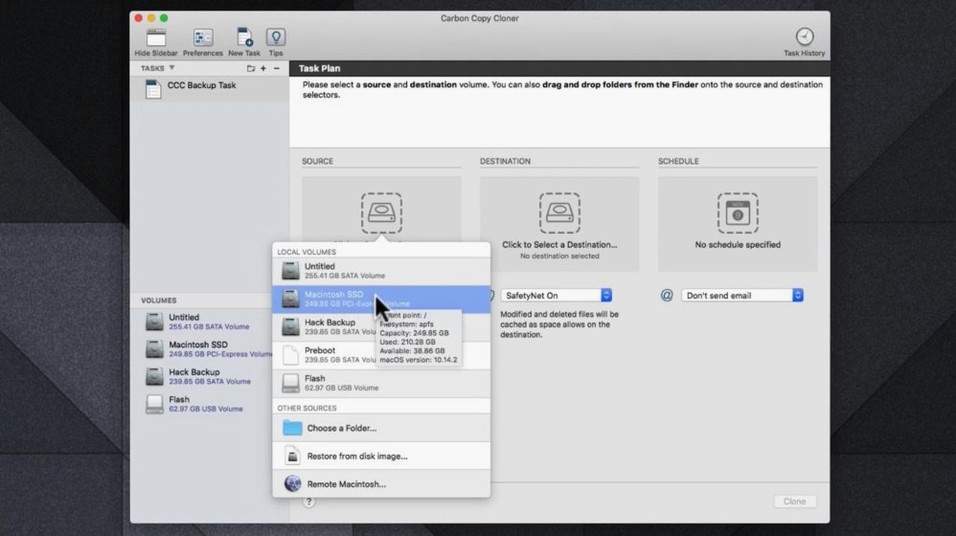
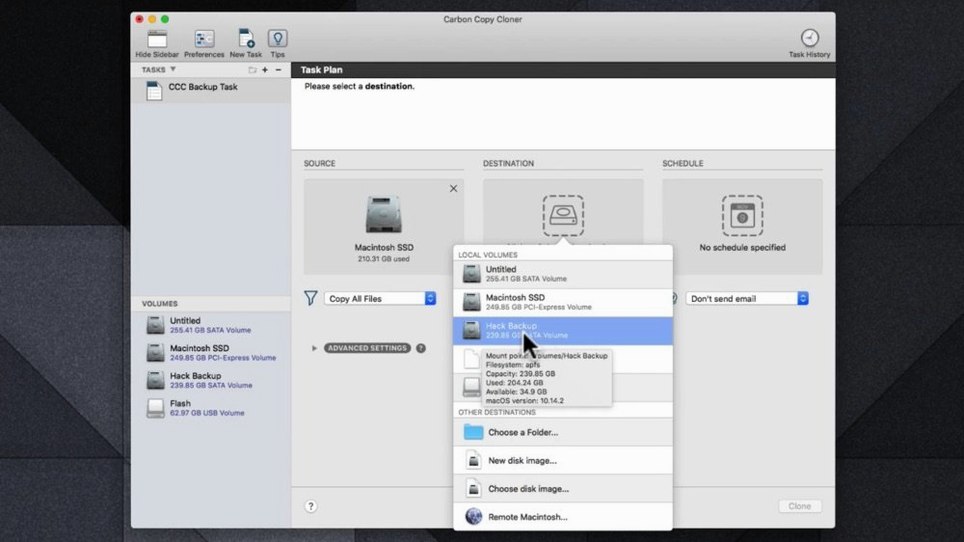
Later, before lunch, a new project folder needs a one-off copy to an external SSD. The user opens the main CCC window from the Dock. The source list appears on the left, destinations on the right. Dragging the project folder onto the source well takes a second. The destination SSD is already plugged in and mounted; CCC recognises it and pre-selects the last-used volume. One click on “Clone” starts the task. A progress bar fills steadily, and a small arrow reveals a live file list. Midway through, the user spots a large cache folder that does not need copying, so they pause the task, add the folder to the exclusion list in the task settings, and resume. The copy finishes in under three minutes. The user ejects the SSD, closes the lid, and steps away.
That rhythm — a scheduled background task doing the heavy lifting, a manual copy handled in seconds — is where CCC sits most naturally. It does not demand attention. It becomes visible only when a destination is offline or a disk is too full, and even then it raises a plain notification rather than a modal alert.
Runs alongside Time Machine on the same machine without conflicts
CCC 7 cooperates with several parts of macOS without overlapping their jobs. Time Machine and CCC can run on the same machine targeting different volumes; they do not step on each other because CCC works at the file-and-folder level while Time Machine uses its own versioned store. A common arrangement is a CCC clone for a bootable spare and a Time Machine disk for hourly snapshots. The two schedules coexist without special configuration.
Cloud sync tools — Dropbox, OneDrive, the Files.app desktop integration — sit upstream of CCC. A typical setup syncs working files to the cloud, and CCC picks up the local copies during its nightly run. The cloned volume then contains the same synced state that existed at backup time, which can be useful when broadband is slow and a full cloud restore would take hours. CCC also respects macOS volume ownership and permissions; a clone made from a user account with FileVault enabled remains encrypted on the destination if the destination is APFS and encryption is turned on. The clone can be unlocked with the same password on another Mac.
Snapshot support ties into APFS. After a clone, CCC can keep a series of snapshots on the destination, accessible via Finder or Disk Utility. A user who accidentally deletes a file can browse yesterday’s snapshot without opening CCC at all. That makes the clone feel less like a static copy and more like a lightweight, rolling archive — though it does not replace a dedicated versioning tool.
A full migration workflow, start to finish
Moving to a new Mac is a task where CCC 7 fits naturally. Here is one plausible sequence, using only the software and what macOS provides.
- On the old Mac, connect an external SSD with enough capacity for the entire internal drive. Open CCC and select the internal drive as the source, the external SSD as the destination. Under “SafetyNet,” leave pruning off for this run to keep every file intact.
- Click “Clone.” CCC copies the full volume. Once finished, the SSD contains a bootable copy of the old Mac. Test it by restarting and holding Option; select the external drive and confirm the system starts and apps launch.
- Shut down the old Mac. Unbox the new Mac and start it. When Setup Assistant appears, choose to migrate data from a Mac, Time Machine backup, or startup disk. Point it at the external SSD. macOS Migration Assistant reads the clone and transfers user accounts, settings, and applications.
- Once migration finishes, log into the new Mac and check that files and licences carried over. Download and install CCC 7 on the new machine (the Universal build runs natively on Apple Silicon).
- Set up a fresh scheduled task pointing at the new internal drive. The external SSD can now serve as the first backup destination for the new machine, or be reformatted and repurposed.
The whole process leans on one full clone. No intermediate cloud upload, no daisy-chained Thunderbolt target mode. For a user with a large photo library and several virtual machines, the initial clone might run overnight, but the hands-on steps are brief. The bootable test in step 2 adds real confidence before wiping the old machine.
A tuned pipeline saturates a spinning hard drive easily
CCC 7 runs its copy operations through a tuned pipeline that saturates a spinning hard drive easily and keeps an NVMe SSD busy. A full clone of a 512 GB internal drive to a Thunderbolt SSD, with the source lightly loaded, completes well within an hour. Incremental backups are where the software feels quickest: scanning a million files for changes takes under two minutes on a recent Mac, and only the differences move across the wire. The safety-net pruning, when enabled, adds a modest extra pass but rarely becomes a bottleneck.
Stability is uneventful in the best sense. Crashes are infrequent; the background helper restarts silently if it ever exits. Scheduled tasks that collide with system sleep are deferred until the Mac wakes, and CCC picks up where it left off. One long-running clone paused for an accidental USB disconnection resumed after re-plugging without starting over, which saved a good forty minutes on a slow external disk.
Memory use stays low. The main window idles around 90 MB; during a copy, it climbs to roughly 180 MB while the file list is visible. CPU usage during an incremental backup hovers in single-digit percentages because the heavy lifting happens in the copy engine, which is I/O-bound. On an M1 MacBook Air, a scheduled clone running while Safari, Notes, and a code editor are open causes no detectable fan activity — the Air has no fan, but the point stands: the machine stays cool and responsive. The menu bar helper consumes negligible resources, and disabling it reclaims almost nothing, so there is little reason to quit it.
For users who obtain the software through channels like Carbon Copy Cloner 7 Mac torrent or Carbon Copy Cloner torrent, the resource picture remains similar — the binary is the same Universal build — though macOS Gatekeeper prompts after system updates can be resolved by re-applying the code-signing or adjusting Gatekeeper settings. A Carbon Copy Cloner Mac torrent distribution may also lag a point release behind, missing a fix for an edge-case snapshot bug. Those on a Carbon Copy Cloner Mac crack path sometimes report that the background helper loses its scheduling permissions after a macOS upgrade, requiring a reinstall. The Carbon Copy Cloner 7 torrent build, when its signing is refreshed, typically maintains those permissions across upgrades.