Aspecten
 Download (220 MB)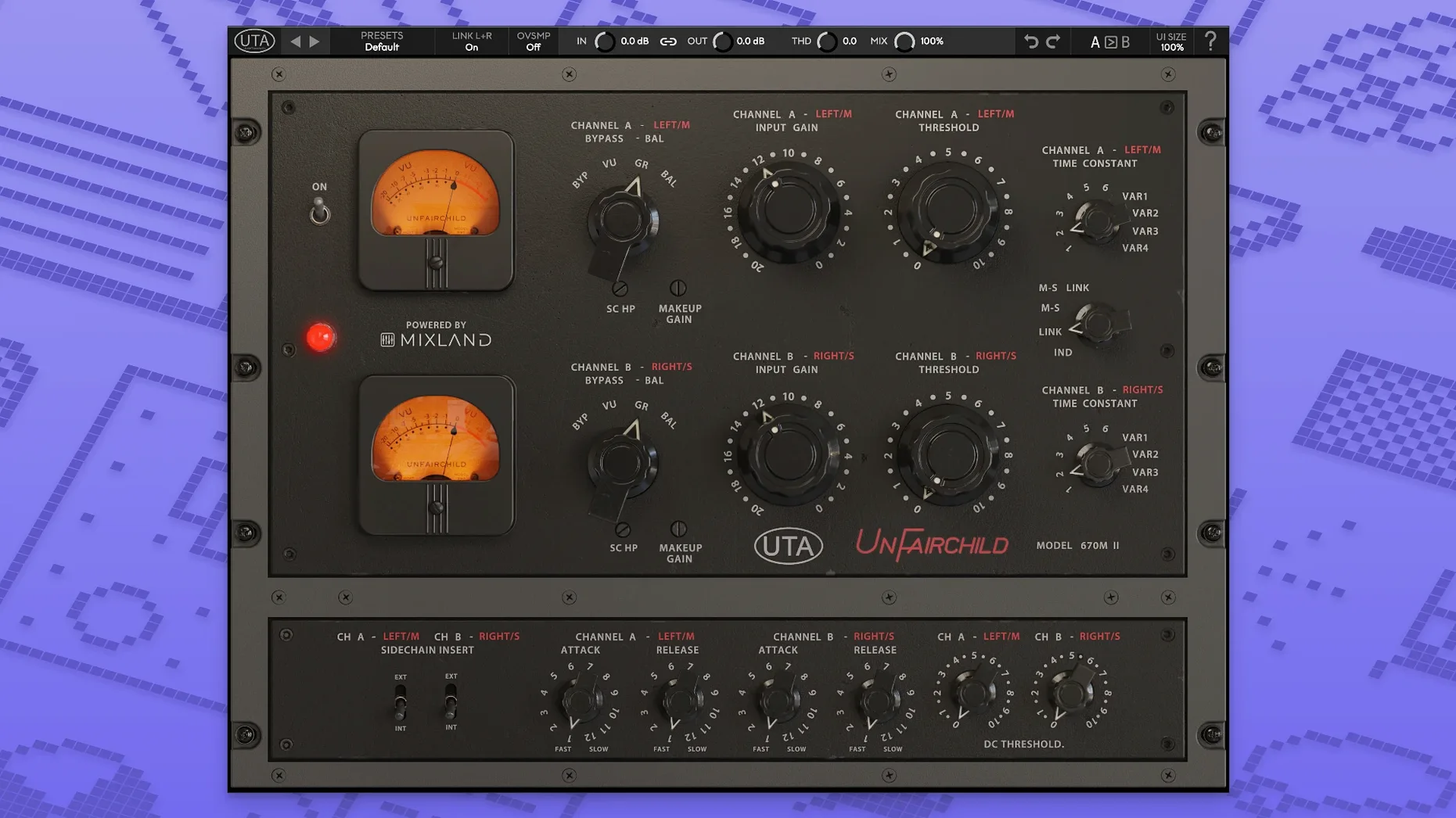
Mixing into a static, unyielding master bus compressor can flatten a track's dynamics before the arrangement has room to breathe. The UnFairchild plugin addresses that by emulating the behaviour of a valve-driven vari-mu circuit, where gain reduction folds into the signal without the hard clamp of a VCA. The result is a form of density that sits behind the source rather than on top of it, which makes it useful when the goal is cohesion rather than obvious squashing.
| Detail | Value |
|---|---|
| Current version | 1.0.8 |
| macOS | 10.13 and later |
| Architecture | Intel and Apple Silicon |
| Developer | UnderTone Audio |
The plug-in offers six preset time constants taken from the mkII hardware, plus four variable positions that let you set attack and release behaviour outside the fixed curves. A DC Threshold control sits at the centre of the compression action, determining how the side chain reacts to asymmetrical programme material—handy on drum buses where a kick drum can yank the needle harder than the snare. There is also a fine left/right balance adjustment, which can correct the slight image tilt that dual-mono vari-mu topologies sometimes introduce. A wet/dry control brings parallel compression directly into the plug-in window, so blending the compressed and dry signals does not require extra routing. Across vocals, the unit adds a sense of forward placement without raising sibilance, and on drums it rounds off transient edges while keeping the body of the kit intact. The output level control makes gain staging straightforward once the desired amount of squeeze is dialled in.
One compressor on the drum bus
A mix engineer preparing a track for a client sits with a dense multitrack session. The drums are punchy but separate—the kick, snare and overheads each occupy their own space without much glue. The aim is to knit them together without losing the snap of the snare or turning the cymbals brittle. The UnFairchild is inserted on the drum bus with a moderate time constant from the six presets, the needle barely moving at first. The DC Threshold is nudged until the kick stops yanking the gain reduction in isolation and the whole kit begins to breathe as one. A touch of wet/dry mix keeps the transients articulate underneath the compressed layer. Ten minutes later the drums sit in a pocket that feels dense but not crushed, leaving headroom for the bass and vocals to find their own place.
DAW and system‑wide routing on macOS
The plug-in works inside any DAW that hosts AU or VST3 formats on macOS, which covers Logic Pro, Ableton Live, Cubase and Reaper without extra configuration. System-wide audio routing apps like Loopback or BlackHole can feed it a signal from outside the DAW for sound design or live processing, though most users will keep it inside a mixing session. Apple Silicon support means the plug-in loads natively in Logic Pro on an M-series machine without Rosetta, keeping CPU overhead predictable even when several instances run across a large project. The fine left/right balance control interacts well with the stock pan law settings in Logic and Cubase: a small adjustment can compensate for the subtle stereo shift that occurs when dual-mono compression reacts unevenly to a skewed input signal.
A practical pairing is with a clean digital EQ placed before the UnFairchild. Rolling off sub-bass below 30 Hz before the signal hits the side chain prevents the low end from driving the compression too hard, which can be useful on a full mix where the kick drum otherwise dominates the gain reduction. Another common setup places a tape emulation after the UnFairchild to add a layer of saturation that differs from the plug-in's own THD control—the two harmonic textures stack without blurring into each other. The THD control itself can be automated from a MIDI controller or a track envelope, letting the harmonic density rise during a chorus and drop back during verses.
Alongside other vari-mu plug-ins
The UnFairchild sits in a small group of software vari-mu compressors that model specific hardware units. The Pulsar Audio Mu models a tube mastering compressor with a different feedback topology and a mid/side matrix that permanently alters the stereo routing. The UnFairchild keeps the signal path dual-mono by default, with MS processing available as a switchable option rather than a fixed architecture. That difference matters on sources where the left and right channels carry distinct transient information—overheads recorded with spaced pairs, for example—because dual-mono compression preserves the independence of each channel until you choose otherwise.
Another comparison is the Arturia Comp Tube-STA, which models a variable-mu circuit from a different era and manufacturer. The Comp Tube-STA has a simpler control set and a thicker low-frequency saturation character, but it lacks the DC Threshold and fine balance adjustments that give the UnFairchild its surgical edge on drum buses. The UnFairchild's four variable time constants also offer more flexibility than the fixed attack and release settings on the Arturia, making it easier to tune the compressor to a specific groove.
A third point of reference is the Klanghelm MJUC, a vari-mu design not tied to a specific hardware unit. The MJUC offers three distinct compression modes, one of which pushes into heavy tube colouration. The UnFairchild is more restrained in its harmonic imprint until the THD control is raised deliberately, and its time constant options are more closely mapped to real hardware positions. Engineers who want a broad palette of tube flavours might reach for the MJUC; those who need a specific hardware response for mix bus or drum work often end up with the UnFairchild.
DC Threshold misreading on kick‑heavy material
One frequent mistake is leaving the DC Threshold at its default and wondering why the compressor pumps on a kick-heavy mix. The control is not a set-and-forget parameter—it directly shapes how the detector responds to asymmetrical waveforms. On a drum bus, a low DC Threshold can make the kick modulate the entire kit in an unmusical way. Raising it until the pumping stops, then backing off slightly, usually brings the compressor into a working zone.
Another error is using the wet/dry control as a simple volume balance without checking phase. The plug-in's internal latency is small and consistent, so phase issues are rare, but aggressive THD settings can introduce enough harmonic shift that the dry and wet signals interact in ways that thin out the low end. Flipping the phase of one channel on a dual-mono source and listening for cancellations quickly reveals whether the blend is working constructively or not.
Some users treat the fine left/right balance as a pan control, which it is not. The adjustment is designed to compensate for tiny gain differences between the two sides of the compressor circuit, typically fractions of a decibel. Cranking it to extremes can skew the stereo image rather than fix it. A better approach is to insert a correlation meter after the plug-in and use the balance knob only to bring the stereo centre back to zero after the compressor has shifted it.
Lastly, the true bypass button is sometimes mistaken for a quick A/B comparison tool. Because it switches the plug-in's processing entirely out of the signal path rather than simply stopping gain reduction, clicking it while audio plays can cause a brief interruption in some DAWs. Using the DAW's own plug-in bypass or a dedicated A/B slot is a smoother way to compare processed and unprocessed signals.