Aspecten
 Download (4.4 GB)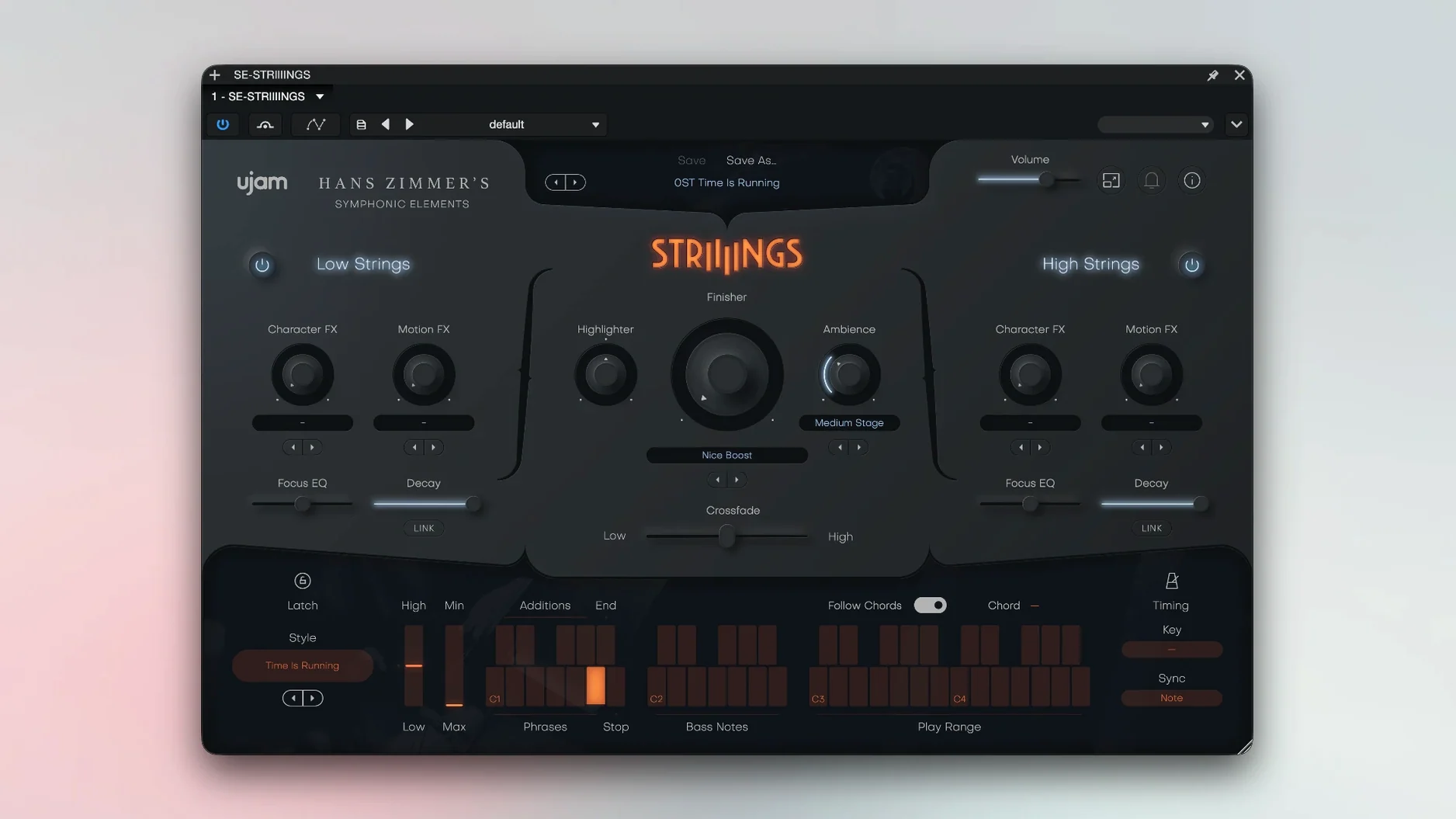
You place the plug-in on an instrument track, load the default patch and play a chord. One hand sits in the bass register, the other an octave and a half higher. Instead of a single mass of strings, you hear two distinct sections — basses and celli sitting low, violins and violas above — each responding to its own set of controls. It is a practical way to sketch a divisi string arrangement without loading separate libraries.
The interface is built around this split. Low Strings and High Strings occupy the left and right sides of the window, each with independent volume, pan, and character adjustments. On the Low side you might pull back the brightness to keep the foundation dark and weighty. On the High side you can open the filter and push the expression slider forward, making the upper line cut through a dense mix. The two layers never blur into one another unless you want them to, because a central Crossfade control lets you blend them in real time — useful for transitions where the focus shifts from a low drone to a soaring melody.
UJAM describes the series as modern orchestral instruments, and the sound fits that description. The samples lean more toward processed, cinematic texture than a concert hall recording. There is a built-in finish to the tone — a touch of compression, a sense of space already baked in — that makes the plug-in sit in a pop or hybrid orchestral production with very little additional processing. You can treat it as a sound design tool as much as a string section, pushing the character controls beyond their neutral positions to get synthetic swells and bowed-noise textures.
Each section adjusts independently, so a single instance can cover both the weight and the air of a string arrangement. The trade-off is that you are working within the baked-in hall sound and the fixed split between low and high registers. For quick layering and texture work, though, that limitation is also what makes it fast to use.
Drops into Logic as a standard instrument slot
STRIIIINGS loads as an AU, VST3 or AAX plug-in, so it slides into most Mac production setups without friction. In Logic Pro it appears in the instrument slot like any software synth; you assign it to a track, open the window and play. Ableton Live users can drop it onto a MIDI track and immediately start capturing ideas. The plug-in responds to standard MIDI data — notes, velocity, mod wheel — and does not demand its own routing scheme or a special host. That makes it straightforward to use alongside other virtual instruments in a template, whether you are stacking it under a piano library or running it next to a dedicated solo cello.
Automation follows the host DAW conventions. You can draw in expression changes, automate the Crossfade slider over a transition, or map the filter to a hardware controller. The parameters are exposed to the host, so they show up in automation lanes without manual configuration. For composers who build large orchestral templates in Cubase or Studio One, STRIIIINGS adds a texture layer that sits comfortably between a full orchestral string patch and a synth pad. It also plays well with macOS features like Audio Unit hosting in third-party utilities and the system-wide audio routing of BlackHole or Loopback, should you need to feed its output into another application for further manipulation.
Runs locally after a one-time activation
One common question is whether the instrument needs an always-online connection. It does not. Once installed and activated, it runs locally on your Mac. The plug-in checks for its licence on launch — a quick, silent process — and then stays available for the rest of the session. Another question concerns the split between Low and High Strings: can you play a full five-octave string chord and have the plug-in sort the voicing automatically? No, it does not re-voice or re-route notes based on pitch. You play what you want in each register, and the two sections respond to the notes you feed them. If you play a large block chord spanning three octaves, both layers will sound across their respective ranges, which can create an interesting blend but is not the same as an auto-divisi engine.
Users also ask about the activation routine. The package includes install and activation instructions, and a small quirk worth noting is that the plug-in should be opened twice the first time you launch it. On a first run it may not immediately validate; closing and re-opening the window settles it. This is a one-time step, not a recurring nuisance. As for compatibility, the 64-bit requirement means it will not appear in older 32-bit hosts or on versions of macOS earlier than 10.14 Mojave. Anyone still running a pre-2018 system would need to look elsewhere, but on a modern Apple Silicon or Intel Mac from the Mojave era onward, it loads reliably.
Patch changes feel instant on Apple Silicon
On an Apple Silicon machine the plug-in opens quickly — typically within a second or two — and patch changes are near-instant. The sample set is compact enough that it does not dominate your RAM budget; 4 GB is the stated requirement, and in practice a typical instance sits well under that ceiling. Loading a project with multiple instances will add up, as with any sample-based instrument, but a single STRIIIINGS track alongside a handful of other plug-ins rarely pushes an 8 GB system into swap territory. On Intel Macs the performance is similarly comfortable, though patch-loading times can be a fraction longer on older quad-core chips.
Stability in daily use is uneventful in the best sense. The plug-in does not drop out during tempo changes, does not require buffer-size adjustments beyond what the project already demands, and does not leak memory over long sessions. In a project that runs for several hours with repeated saves and export passes, STRIIIINGS stays responsive. The only small note on resource use is that the onboard reverb and character processing add a negligible CPU cost — you cannot disable them entirely, but the processing is light enough that it rarely factors into a decision to freeze a track. On a large scoring session with sixty tracks it might be prudent to bounce the part once it is finalised, but that is true of most virtual instruments.
Beatmakers get string textures without orchestral chops
Beatmakers and pop producers looking for a quick string texture that does not need orchestral programming knowledge will find it immediately useful. The preset library — more than 200 sound designer patches and 60 styles — covers moody drones, rhythmic bow chops, processed sustains and hybrid textures that sit nicely behind a vocal or a trap beat. You can load a patch, tweak the two faders, and have a usable part in a few minutes.
Film and game composers working to tight deadlines benefit from the baked-in sound. Because the samples already carry a cinematic finish, you spend less time on mixing and more time writing. The Crossfade control alone can replace a handful of automation lanes when a cue shifts from tension to release. Hybrid orchestral writers, who blend real string libraries with synthesised elements, get a bridging layer — something that is not quite organic and not quite synthetic, which sits in the gap between a sampled orchestra and a wavetable pad. It is less suited to someone who needs detailed, multi-articulation divisi sections with individual player control, but for the producer who wants a string section that loads fast and sounds finished, STRIIIINGS fits the brief.