Aspecten
 Download (2.1 GB)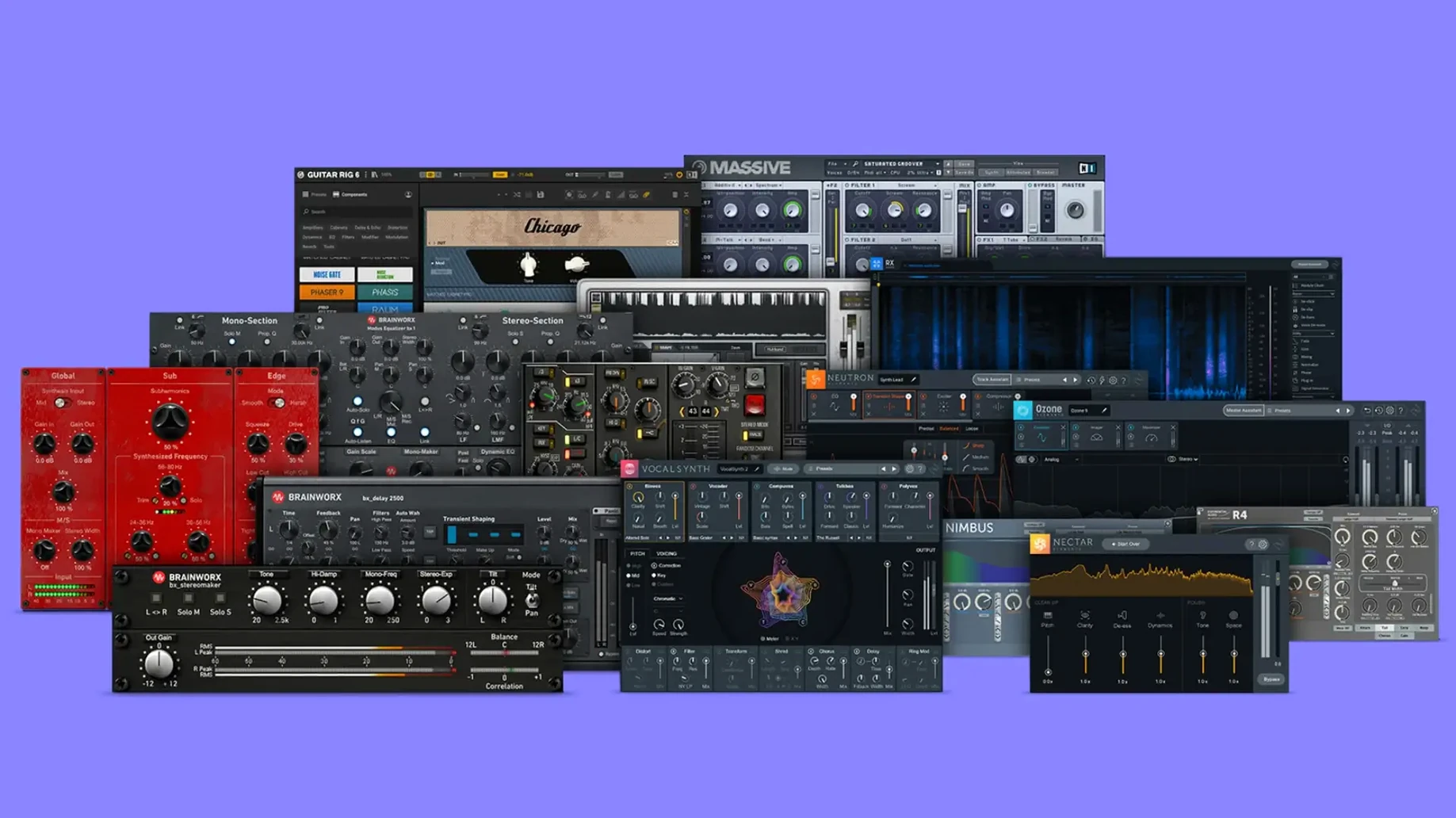
The current release, 2025.06.16 Fix, gathers several Brainworx processors in one installation. Plugin Alliance describes Brainworx as a founding development partner, and the selection here moves from mix bus compression to surgical equalisation and console colour.
SSL-style glue and midrange shaping in one suite
- Mixing and mastering engineers who want a consistent set of analogue-modelled tools
- Projects that benefit from the push and pull of a SSL-style bus compressor and a more modern take on glue
- Shaping the midrange with the proportional-Q curves of the bx_2098 EQ
- Adding the headroom and crosstalk behaviour of a classic desk via the bx_console SSL 4000 E or AMEK 200
Fixed lineup means you live with the exact 10 plugins
- The bundle is a fixed set; you cannot swap one plugin for another Brainworx title outside the collection
- Console emulations add CPU load per instance, which stacks up quickly on larger sessions
Brainworx bundle versus Softube Console 1 ecosystem
Put the Brainworx bundle next to Softube’s Console 1 ecosystem and the differences in approach surface immediately. Softube ties its channel strips to a hardware controller; the software and the knobs are sold as a single idea. The Brainworx collection works without dedicated hardware and leans more on the Tolerance Modelling Technology baked into each emulation — component variation, channel-to-channel inconsistencies, the stuff that makes a console feel like a console rather than a clean digital strip. Softube’s sound is slightly more polished out of the box, while Brainworx tends to give you the raw desk behaviour and lets you decide how much grit to dial back.
Against the Waves Abbey Road Collection, the comparison shifts toward flavour. Waves models specific rooms and desks from one famous studio with a consistent sonic signature. The Brainworx bundle pulls from a wider pool: a 1970s Amek desk, a SSL 4000 E, a Townhouse compressor, a bass amp. The Waves collection feels curated around a single building; the Brainworx bundle feels like a rack assembled by an engineer who works across genres and decades. Both support Apple Silicon natively, so performance is comparable on current Macs, though Brainworx console strips can be heavier per instance when crosstalk and full channel modelling are engaged.
Plugin Alliance’s own Mega Bundle is the third obvious point of reference. The Brainworx bundle here is a subset — no Unfiltered Audio, no SPL, no Lindell. It covers the Brainworx-developed core, minus a few flagship titles like the bx_masterdesk True Peak or the newer bx_console Focusrite SC. For a mix engineer who already knows which Brainworx tools they reach for, the tighter selection means less scrolling through a bloated plugin list. The trade-off is that you do not get the full Alliance catalogue when a future project calls for something outside the Brainworx design language.
Quiet stability patches instead of feature drops
The 2025.06.16 Fix release was a stability patch rather than a feature drop. Plugin Alliance use a rolling update model across their catalogue, and Brainworx plugins tend to receive improvements quietly — better Apple Silicon memory handling, smoother GUI rendering on high-DPI Mac displays, and the occasional recalibration of a TMT algorithm when a real reference unit drifts out of tolerance.
In practice, the most noticeable shift over the last twelve months has been the gradual reduction in GUI lag on M2 and M3 machines. Earlier builds of the console emulations would stutter when dragging a gain knob while the transport was running at a low buffer. That is largely gone now. The bx_townhouse Buss Compressor saw a subtle revision to its sidechain filtering a few cycles back; the compressor grabs a fraction less sub-bass before clamping down, which makes it easier to push the needle without losing the low end of a kick drum. The bx_glue compressor gained smoother auto-release behaviour — small change on paper, but it tucks transients more predictably when riding a full mix bus at 1–2 dB of reduction.
What has not changed is the activation flow. The 2025.06.16 Fix release continues to use a standard mounted-disk-image installation with no online account checks, which keeps sessions loading predictably across different user profiles on the same Mac.
Assign TMT channels across your console instances
Brainworx plugins ship with sensible defaults, but a few tweaks pay off immediately in a working session.
- bx_console SSL 4000 E — TMT channel count. The default randomisation is fine for a single instance, but when you spread eight instances across a drum group, manually assign channels 1 through 8. The accumulated component variation mimics a real desk more convincingly than random scatter, which can overdo the stereo width differences.
- bx_digital V3 — mono maker frequency. The default crossover for mono summing sits at 150 Hz. For modern electronic mixes with a tight kick, pulling it down to 80–100 Hz keeps the sub-bass mono without narrowing the punch above it. The stereo width control above that crossover is best backed off to 110–115% for most masters; the 200% setting introduces phase artefacts that fold down poorly to mono.
- bx_glue — sidechain filter slider. The high-pass filter in the sidechain defaults to 60 Hz. On a drum bus, try 120–140 Hz. The compressor stops chasing the kick fundamental and starts responding to the snare and overheads, which glues the kit without pumping.
- bx_masterdesk Pro — resonance filter placement. The resonance filter defaults to pre-compression. Swap it to post for material that already has a solid dynamic contour; the filter then shapes the tone without influencing how hard the compressor grabs. The foundation knob is easy to overuse — start at 9 o’clock, not 12, and bring it up only if the low end genuinely thins out.
- bx_2098 EQ — proportional Q behaviour. The 2098 tightens its Q as you boost farther from zero. Beginners often fight this by stacking smaller boosts across adjacent bands. Instead, use a single broader boost on the band that matches the source’s natural resonance and a narrow cut on the band above it; the proportional-Q design works with you rather than against you.
Full console emulation on every track before finishing the arrangement
The most common early misstep is enabling the full console emulation — crosstalk, noise, every TMT channel — on every single track in a 60-channel session before the arrangement is even finished. The cumulative CPU load aside, the noise floor stacks and the crosstalk interactions turn into a smear that is difficult to unpick later. Start with the emulation on the main bus groups — drums, bass, vocals — and add channels only when the mix structure is locked.
Another pattern is treating the bx_townhouse Buss Compressor like a digital peak limiter. The Townhouse model was built from a real SSL-style compressor that has a fast attack, but digging in beyond 4 dB of reduction with a 0.1 ms attack time flattens transients in a way that no amount of make-up gain can repair. Let it breathe with a 10 ms attack and aim for 2–3 dB on the loudest chorus; the punch stays intact and the compressor does its glue job without sounding squeezed.
Beginners also tend to overlook the output trim on console strips. Driving the input harder for saturation without pulling the output down results in a louder signal, and the brain interprets louder as better. Match levels with the trim control and judge the saturation on its tone, not on the volume bump. The bx_console AMEK 200 is especially prone to this because its input stage saturates gracefully and the extra loudness is seductive.
Finally, the bx_rockrack V3 amp sim can trip people up with its cabinet IR loader. Loading a third-party impulse response without disabling the built-in cabinet section runs two cabs in series, which produces a hollow, phase-cancelled tone that sounds like a broken speaker. Always bypass the internal cab before adding an external IR.
Single installer drops all plugin formats at once
Does the bundle install as a single package or individual plugins? The disk image contains one installer that places all the plugins in the standard Audio Unit, VST and VST3 folders. After installation you can delete the component files for any plugin you do not need, and the rest will continue working. There is no dependency linking them together.
Will it sit alongside other Plugin Alliance installations without conflict? Yes. The Brainworx bundle shares the same plugin identifiers as the individual Brainworx titles distributed through Plugin Alliance. If you already have some of them installed from the full Plugin Alliance bundle on Mac, the versions will simply align to whichever is newest. No duplicate entries appear in the DAW.
How heavy are the console plugins on an Apple Silicon Mac? A single instance of the bx_console SSL 4000 E with crosstalk on uses roughly the same CPU as two instances with crosstalk off. On an M1 Pro, a 32-channel session with full emulation on every strip runs at about 40–45% total DSP load at a 256-sample buffer, which leaves room for a few heavier reverbs. On Intel Macs from 2018 onward, expect around double that load, so printing stems with console character baked in becomes a sensible workflow choice.
Do the plugins require an internet connection after installation? The 2025.06.16 Fix release does not phone home. Activation is handled during installation and the plugins run offline. This matters for studios that keep their audio machines air-gapped.
Is the bx_bassdude useful on sources other than bass guitar? It was modelled on a Fender Bassman, but running a Rhodes, a synth pad or even a lead vocal through it with the gain backed down adds a midrange push and a soft, compressed top end that works surprisingly well. The EQ section on the amp is broad enough to shape those sources without getting boxy.
Users coming from a brainworx bx bundle or a plugin alliance mac torrent will find the installation familiar — mount the image, run the installer, the plugins appear in the DAW. Those who have tried a plugin alliance torrent in the past will recognise the same directory structure and component layout. For anyone working with a plugin alliance bundle mac torrent or a plugin alliance bundle torrent, the Brainworx collection keeps the workflow identical: all formats in standard locations, no custom plugin manager required.