Aspecten
 Download (1.2 GB)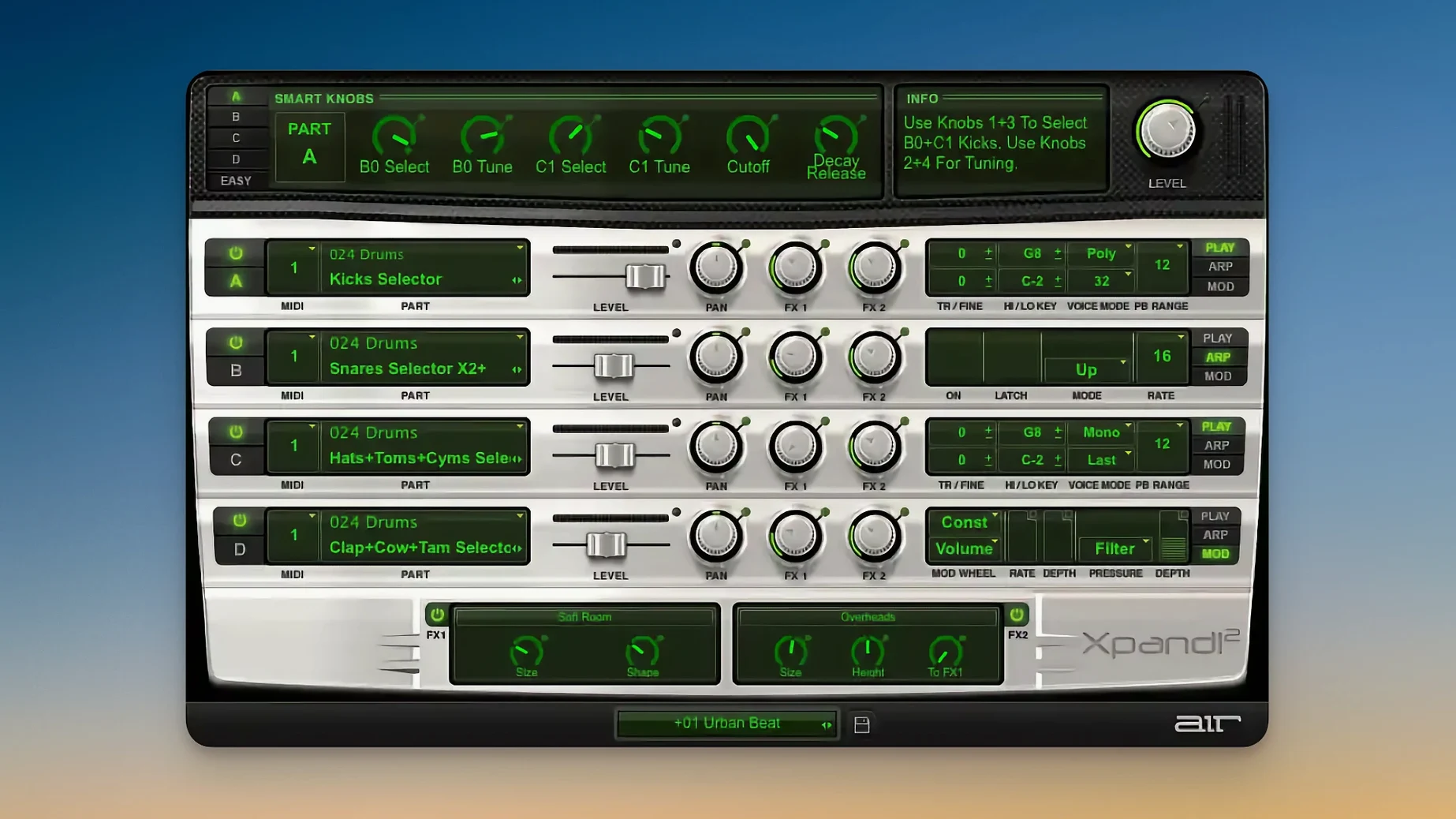
Load Xpand!2 onto an instrument track, dial in a bass-and-pad split, set the bass part to MIDI channel 1 with monophonic low-note priority, and send the pad to channel 2 — all from a single plugin window. That sort of layered patch is the instrument's default way of working, not a special mode.
What kind of tracks does it typically fill?
Keys, pads, basses, strings and brass are where it gets called most. The four-part stacking suits broad chordal beds, but a single slot loaded with a pluck or bell also works for quick melody lines. Because each slot receives on its own MIDI channel, it can double as a sketchpad for multi-timbral arrangements before committing parts to separate instruments.
Where do the effects sit in the signal path?
Two effect processors sit globally on the patch, not per slot. Reverb and modulation or delay treatments apply to the mixed output of all four parts. For slot-level processing, users bus individual parts out to separate DAW channels via multi-output routing.
How does mono mode affect a layered patch?
When a part is set to monophonic, the voice priority — First, Last, Highest or Lowest — decides which note speaks when keys overlap. Setting a bass slot to Lowest priority keeps the root anchored under a right-hand chord slot on another MIDI channel, which helps avoid low-end mud in a busy session.
A handful of users searching for xpand2 torrent or xpand 2 mac torrent are still on version 2.0 from years ago. Those builds predate the scalable interface and Retina support. On a modern Apple Silicon Mac with a high-density display, the difference is immediately visible: version 2.3.1 draws crisp text and knobs at 150 or 200 percent, while older releases look soft and cramped at native resolution.
What the move to Apple Silicon changed in daily sessions
Before the native ARM build arrived, Xpand!2 ran under Rosetta 2. That worked, but larger multi-timbral patches — four slots active, both effect processors engaged, arpeggiators running on two parts — could push a single performance core and trigger occasional buffer underruns at low latencies. The 2.3.1 Apple Silicon binary spreads the load more evenly. Loading a patch now feels instant where there was once a half-second pause, and switching between the 29 categories while playback runs no longer causes a stutter in Logic or Ableton Live.
The update also brought a quieter installer. Earlier versions sometimes left behind preference files that confused DAW plugin scanners. The current package places the component and VST3 in predictable locations, and AU validation passes on the first scan in most hosts.
Opening a track with only Xpand!2
A composer scoring a short documentary needs piano, strings, a soft pulse and a low drone — all before lunch. They open an empty project, load one instance of Xpand!2, and assign four parts across the keyboard. Part 1 holds a felted piano from the Keys category, restricted to C3–B4. Part 2 takes a slow string ensemble from Strings, set to C5–C7 with a slight attack offset. Part 3 gets a muted arpeggiated sequence from Arpeggiated, locked to C1–B2 and synced to host tempo. Part 4 carries a dark wavetable pad from Pads, filling the full range but mixed low. All four parts feed the global reverb and a touch of chorus. A rough cue is playing within ten minutes, with no other plugins loaded. The director hears a cohesive bed, not four separate layers fighting for space.
Six knobs that chase the active slot
Several details in the interface speed up patch building once you know where they sit.
- Smart control shortcuts. The six knobs below the part display — Cutoff, Resonance, Envelope Amount, Release, and two assignable controls — update whichever slot is currently selected. Click a different part number, and the knobs follow. Holding Command while dragging gives finer resolution on any knob, useful for nudging a filter cutoff by half a semitone.
- Arpeggiator latch. Right-clicking the arpeggiator on/off button latches it, so notes keep cycling after you lift your fingers. This works per slot, so one part can drone a held arpeggio while another responds to momentary keystrokes.
- MIDI Learn for smart knobs. Right-click any of the six smart controls and choose MIDI Learn, then move a hardware controller. The mapping sticks with the patch. For live performers, this means filter sweeps and envelope tweaks sit on physical knobs without touching the mouse.
- Copy-paste between slots. Click the small menu icon on a slot and choose Copy Part, then paste it into another slot or another instance. This is faster than recreating a bass sound with identical arpeggiator settings when building variations of a patch.
- Chaos Delay as a texture tool. Among the 50 effects, Chaos Delay is the one that turns a simple sine pluck into a scattered, evolving bed. Setting feedback above 70 percent and modulation depth to mid-range produces unpredictable stereo trails that work well under dialogue.
Re-scan so your DAW sees the right version
After installing, a few minutes of housekeeping shape how the plugin fits into a daily template.
Rescan the plugin list. Some DAWs cache an older version of Xpand!2 if a previous install existed. In Logic, open Plug-in Manager, find AIR Music Technology, and confirm version 2.3.1 appears. In Ableton Live, hold Option and click Rescan in Preferences → Plug-ins. One clean rescan prevents the wrong build from loading in old sessions.
Check the output configuration. The plugin defaults to stereo output. For multi-output use — sending each slot to a separate mixer channel — open the plugin wrapper settings in the DAW and activate the additional outputs. In Logic, this means clicking the “+” button in the mixer channel strip. In Ableton, configure the Audio From chooser on additional audio tracks. Doing this before building a large template saves rerouting later.
Set a default scale percentage. The scalable interface remembers its last setting, but only after the first manual adjustment. Open any patch, drag the scale slider to a comfortable size (125–150 percent works well on 1440p and 4K displays), and close the window. Subsequent instances open at that size.
Bookmark the categories you actually use. The 29 categories range from Arpeggiated to World, but most users gravitate toward five or six. Spend ten minutes tagging favourite patches by dragging them into a DAW user library or saving a folder of “go-to” presets. On a deadline, scrolling through Pads for the third time wastes momentum that a shortlist avoids.
Test mono behaviour early. Load a simple two-part patch: a bass in Part 1 set to monophonic Lowest priority, and a chord stab in Part 2 set to polyphonic. Play a bass note, hold it, and play a three-note chord above. If the bass note cuts out, the part order or MIDI channel assignment needs a tweak. Getting the mono-poly interaction right in a test patch prevents confusion mid-session.
Those who arrived via an xpand torrent link from years ago may find the older interface and Rosetta-only build still functional, but the current version's fit and finish on Apple Silicon make the update worthwhile for anyone who keeps the plugin in regular rotation.