 Aspecten
 Download (2.2 GB)
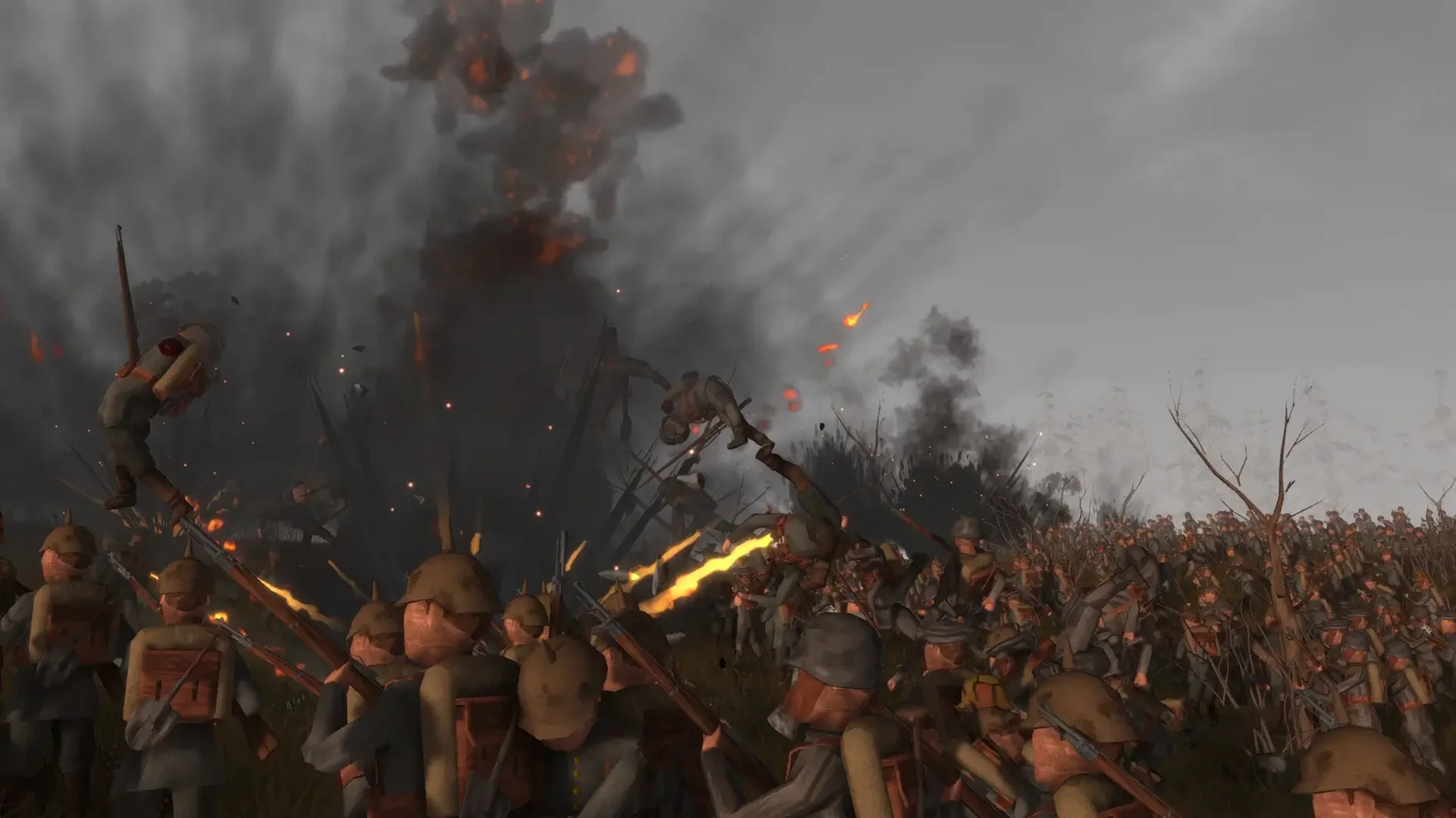
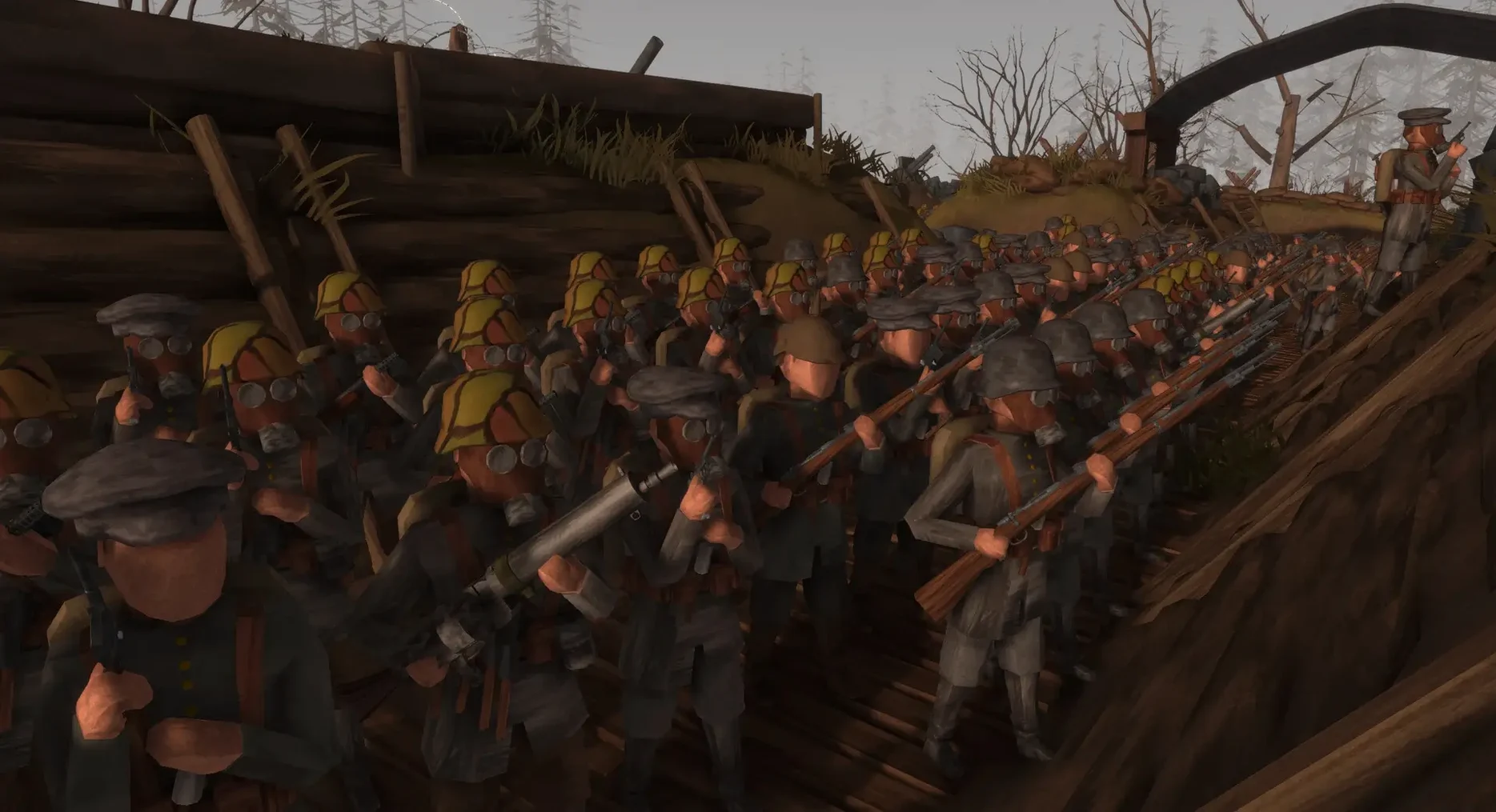
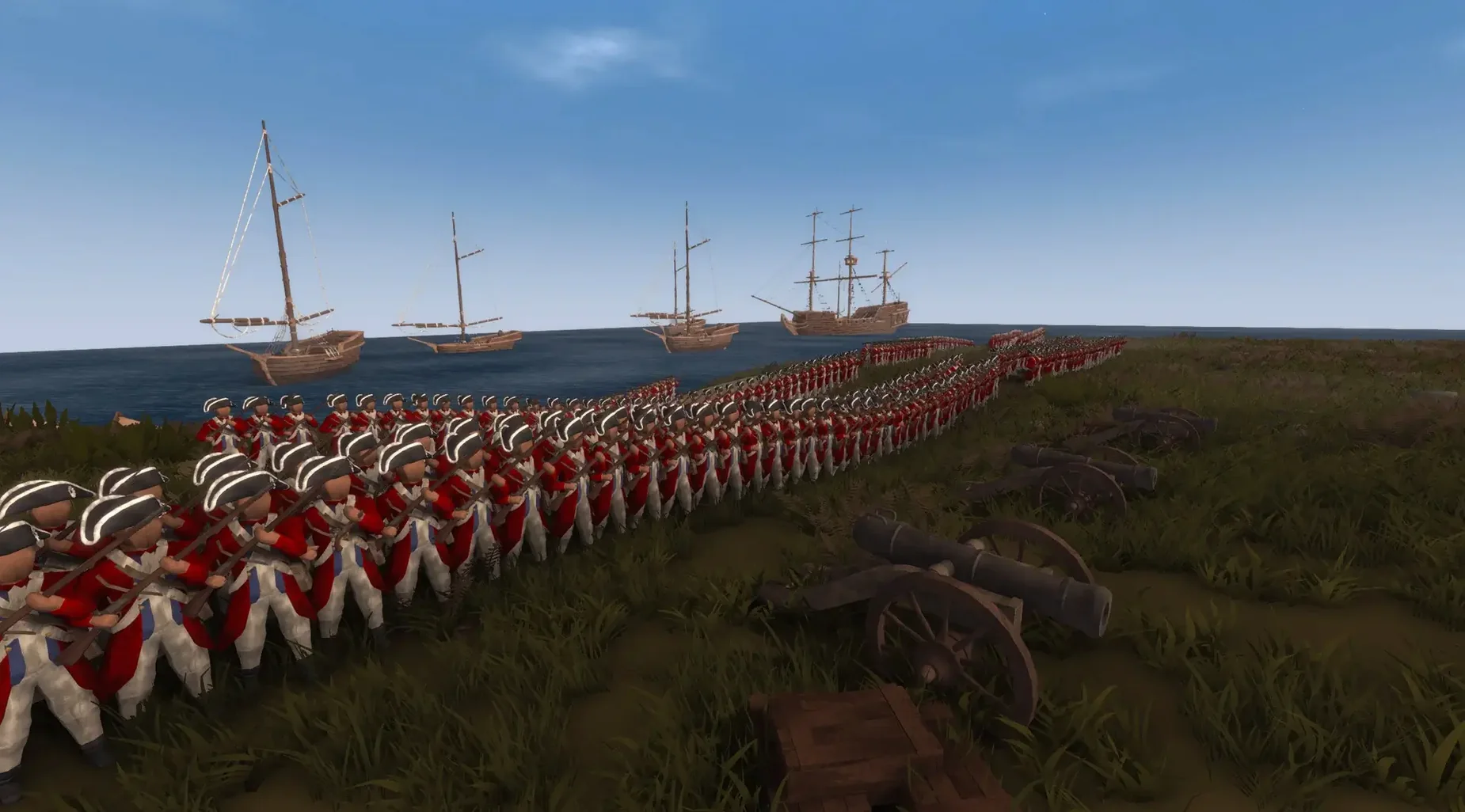
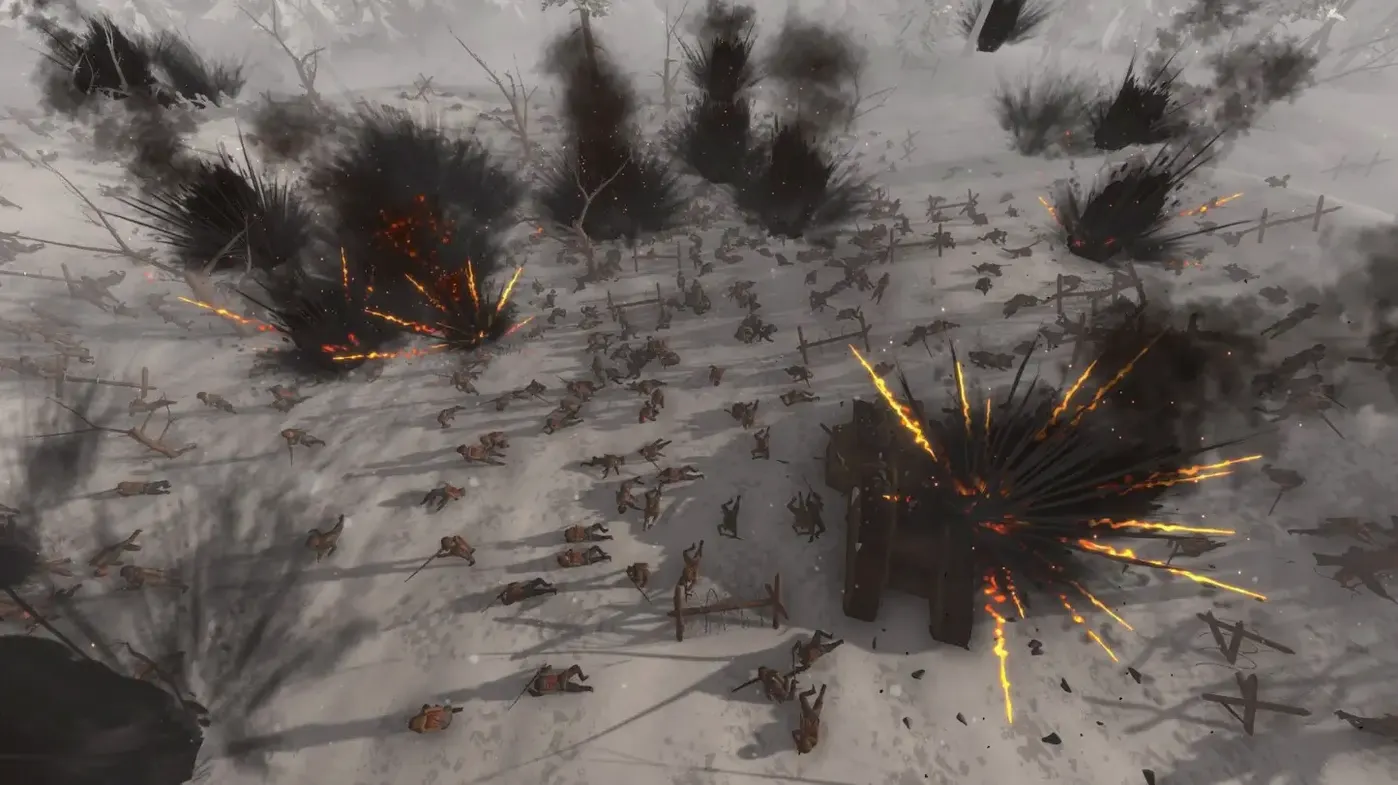
Rising Front is a World War I battle simulator that hands you a rifle, a command map, and a shovel, then drops you onto a procedural battlefield shaped by your own unit placements.
| Detail | Note |
|---|---|
| Current version | 1.01 |
| Languages | English |
| Unit scale | Over 1,000 simultaneous units |
Minute to minute, the game shifts between three modes without pausing. In first-person you fire bolt-action rifles, man stationary machine guns and watch ragdoll physics send soldiers tumbling across no-man’s-land. With a keypress the view pulls back into an RTS overview where you draw movement orders for AI squads, telling infantry to advance behind craters or hold a treeline against a counterattack. When the line stabilises you enter the building system to dig trench networks, place sandbag walls and position field guns. Battles scale past a thousand units, so a single poor decision about barbed-wire placement can cost you a sector ten minutes later. The Workshop content focus means maps and scenarios rotate regularly. Update 1.01 brought a round of bug fixes and small adjustments that cleaned up unit pathing and building snap points, though the AI still occasionally bunches up when crossing narrow bridge maps.
Connecting redoubts before the barrage lands
I launch the game and pick a trench-defence scenario with medium unit density. The overhead map shows a patchwork of cratered fields, a railway cutting and two forward redoubts that need connecting before the first artillery barrage lands.
I start in the build mode. A shovel icon tracks my cursor as I drag trench segments between the redoubts, clicking to confirm each section. Sandbags go onto the forward lip with two clicks per segment — one to place, one to rotate the firing step toward the expected line of advance. I drop a Vickers emplacement at the junction where the railway cutting narrows the approach. The whole setup takes perhaps four minutes. The procedural cover system adjusts sightlines as I work; a poplar copse near the eastern redoubt now partially masks anything crawling along the ditch beneath it.
I switch to the RTS overlay and order three squads forward. One I push into the cutting, another I hold behind the copse, the third I spread along the newly dug trench. Movement lines appear as faint dashed arcs, and I can adjust waypoints by dragging mid-segment nodes. The AI acknowledges with a chirp of whistle audio.
Then I drop into first-person. I spawn at the Vickers post just as the first ranging shell lands two hundred metres east. The ragdoll physics claim a runner caught mid-sprint; his body folds backward over a broken limber. Through the iron sights I track advancing silhouettes. The bolt-action rhythm settles in — aim, fire, cycle, acquire. When the eastern redoubt flares with muzzle flashes I pull back to the map, drag a reserve squad along the communication trench I built earlier, and watch them arrive in time to blunt a flanking push. The session runs twenty minutes without a pause. By the end the cutting is held, but I have lost the copse and half the Vickers crew. The body count sits somewhere north of six hundred.
Ignoring the RTS overlay collapses your flanks
New players often treat Rising Front as a pure shooter. They stay in first-person for entire matches, ignoring the RTS overlay entirely, and wonder why their flanks collapse. The game expects you to move between modes. A trench line left unmanaged in the overhead view becomes a grave marker.
Another early error is building too close to map edges. The procedural cover system can place firing steps with restricted arcs when you jam earthworks against boundary geometry. Leave at least a few metres of open ground behind a trench, or your troops will have nowhere to retreat when a shell collapses the parapet.
Commanding too many squads at once is a subtler trap. The AI handles movement orders competently over open terrain, but when you issue simultaneous advance commands to six units across broken ground, pathfinding bottlenecks emerge — especially on bridge maps. The game runs large-scale battles well, but the AI still needs sequential timing to navigate choke points cleanly. Stagger your orders by ten or fifteen seconds and watch the first unit clear the pinch before sending the next.
A sapper’s afternoon
Consider a player who favours the building system over the gunplay — a defensive-minded type who would rather craft a killing field than sprint across one. For them, a session opens on an empty map with a single command post and a wide, shallow valley ahead.
They spend the first fifteen minutes sculpting. Two parallel trench lines run forward at a slight angle, funnelling attackers toward a central barbed-wire choke. A secondary trench cuts diagonally across the rear, giving a fallback position with enfilade fire onto the wire. They place three field guns on reverse slopes where the procedural cover system grants defilade, each gun sighted onto a pre-ranged landmark: a broken cart, a lone beech, a shell crater rim. Anti-infantry mines dot the gaps between wire sections. When the first wave spawns — a thousand units on the move — the sapper barely fires their rifle. They stay in the RTS overlay, nudging machine-gun crews forward as the wire channel does its work, then pulling them back just before the artillery zeroes in. The battle is won before a single attacker reaches the forward trench. The body count is high, but the build-time investment was higher, and that is precisely the satisfaction the game offers a player who treats earth and wire as their primary weapon.