Aspecten
 Download (2.8 GB)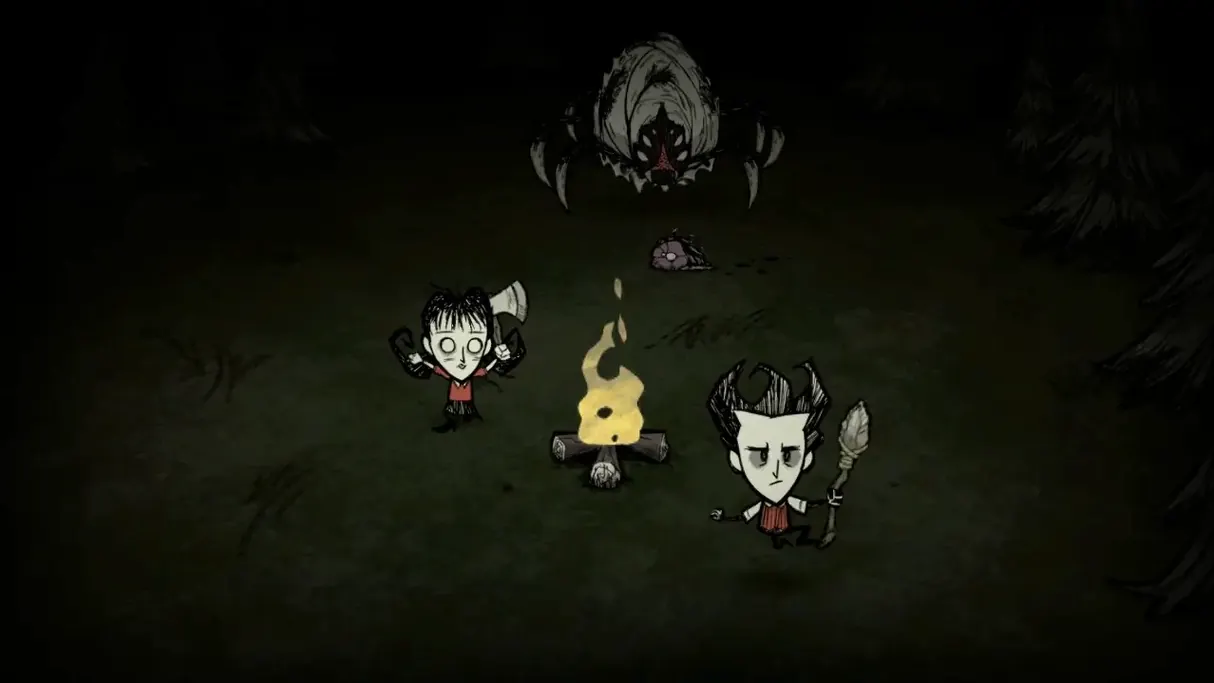
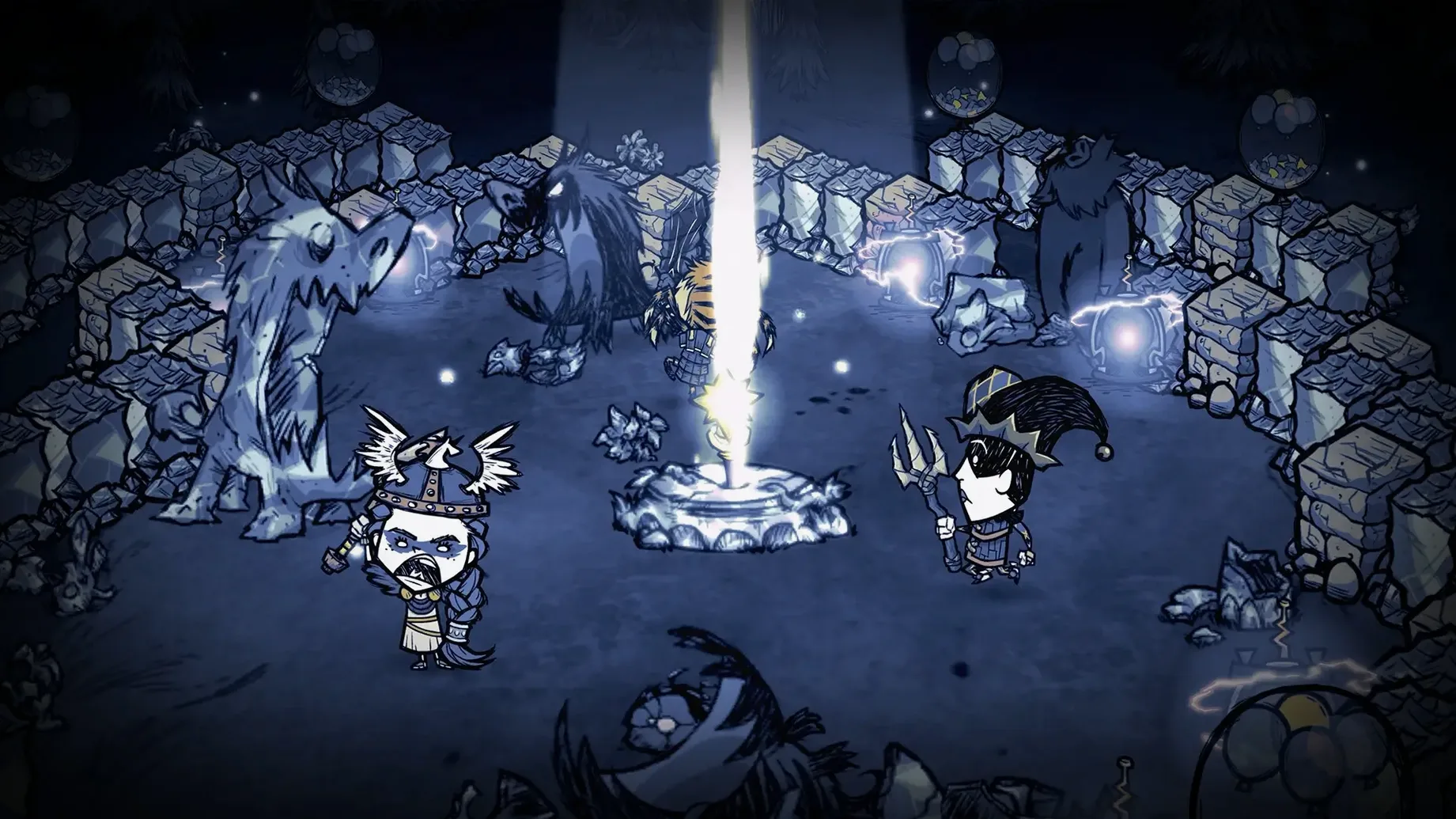
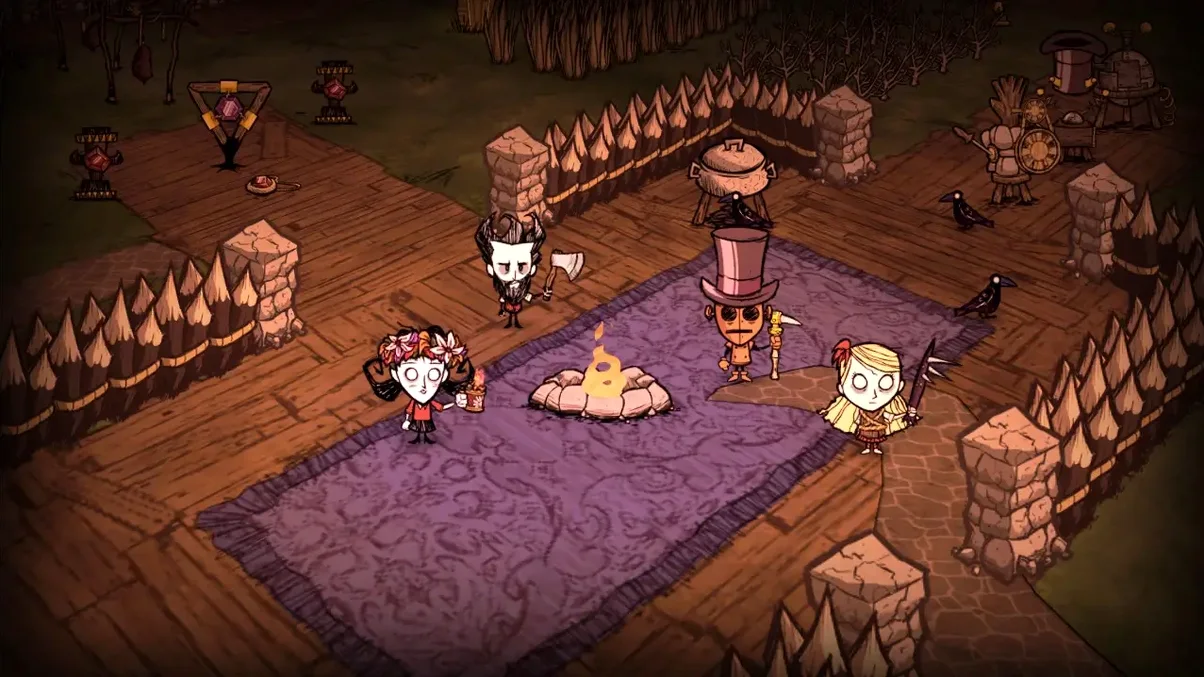
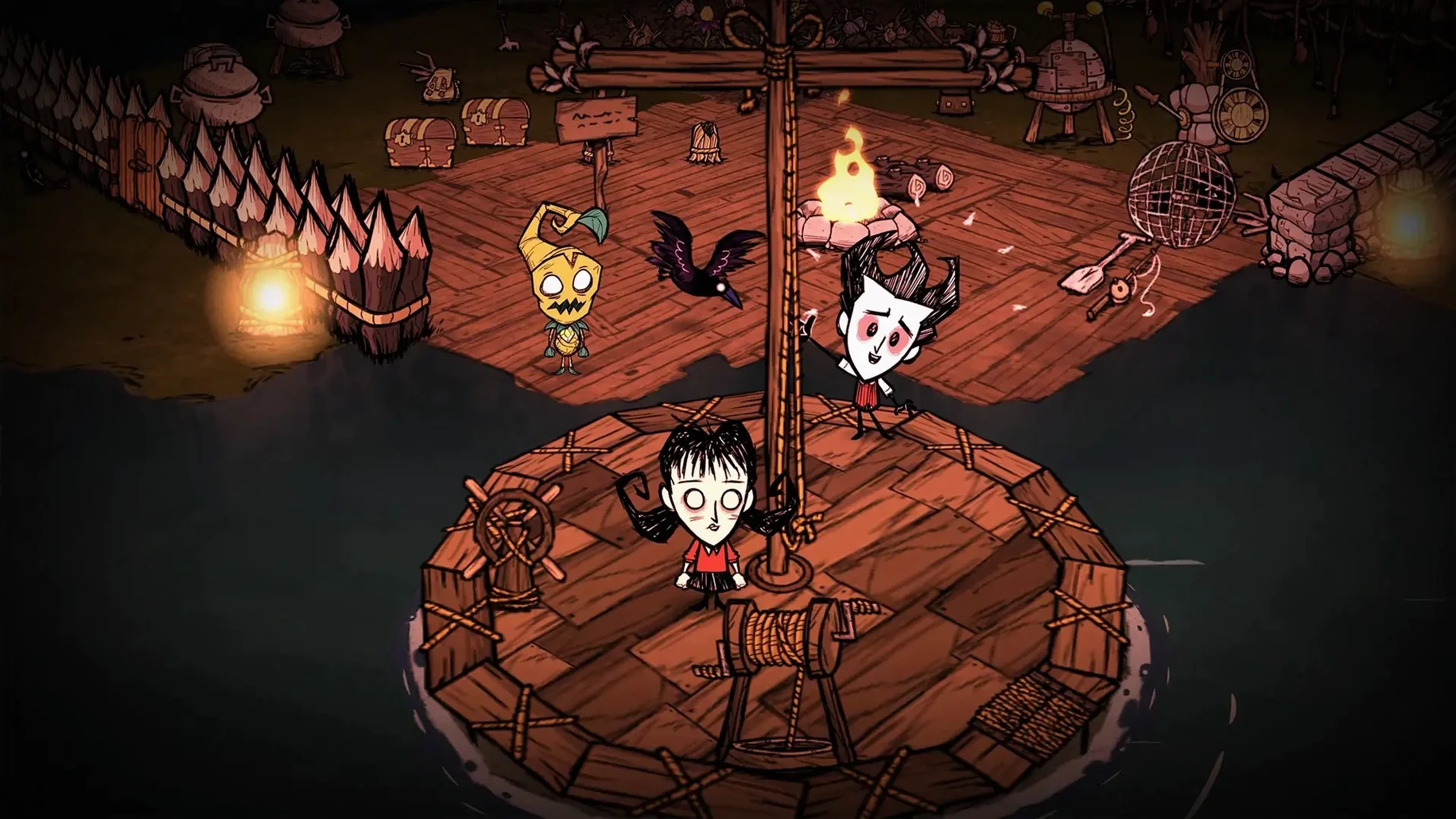
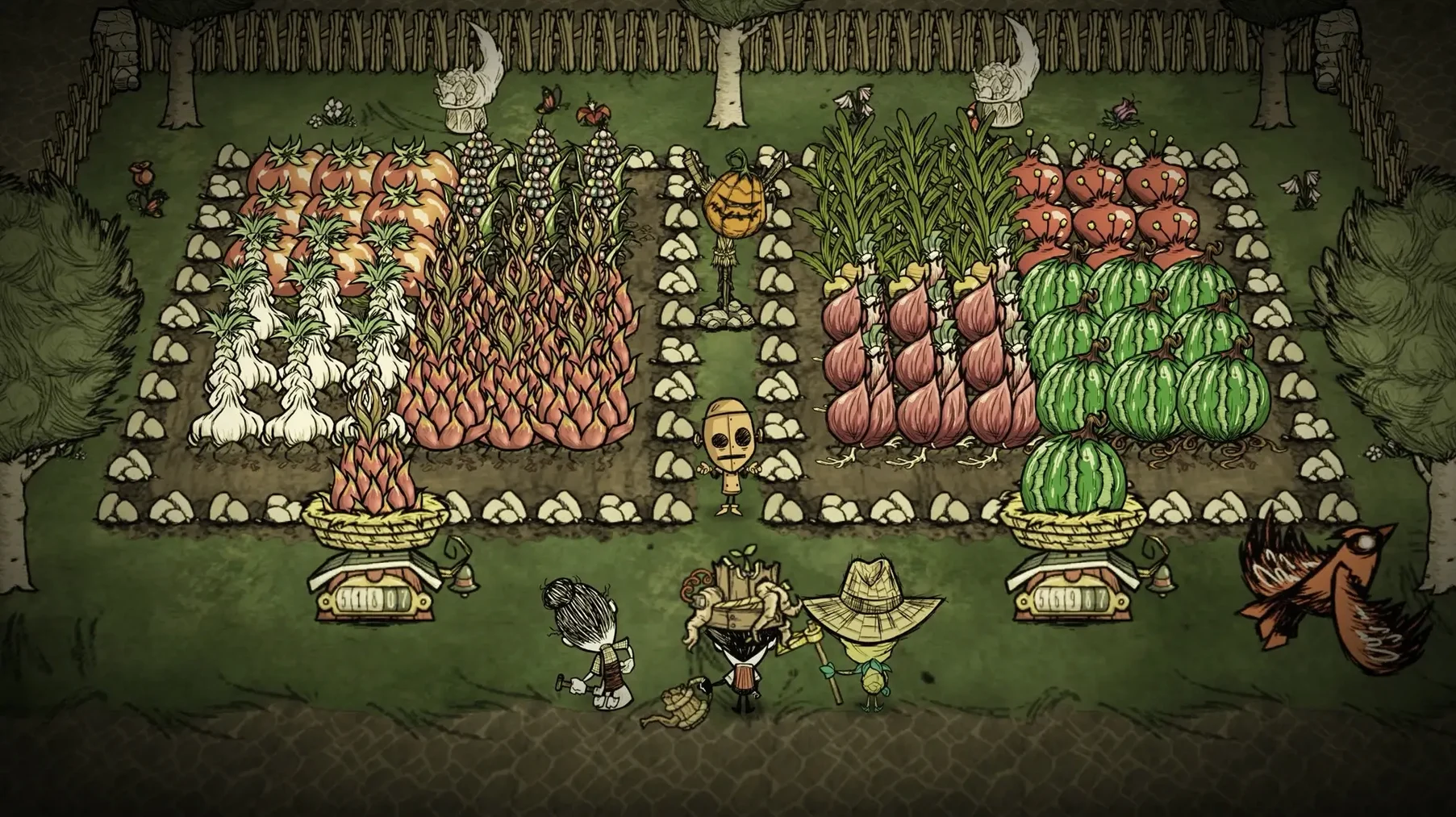
If you have played Don't Starve, you know the basic tension: you wake in a strange wilderness and every nightfall threatens your sanity and your life. Don't Starve Together takes that loop and splits it across two players. The land is the same gothic, paper-cut world, but the demands are doubled, and so is the chaos.
Minute to minute, you are gathering flint, twigs and carrots. You and your partner decide, often without words, who chops trees and who scouts the perimeter for beefalo. By day four you are laying down a science machine, prototyping a backpack, hoping someone remembered to gather silk. A single misread of a hound-wave warning can end an evening's progress.
Best enjoyed as a two‑person panic simulator
- Playing with one friend who already knows the base game
- Sessions built around shared planning and shared panic
- Learning each character's quirks under real pressure
- Runs where communication is the real resource
A separate multiplayer purchase, not a solo‑plus mode
- Standalone expansion; the single-player Don't Starve is a separate purchase
- Designed for two or more players; solo survival requires the original game
- Interface supports English and Simplified Chinese
Runs windowed but ignores AppleScript and Shortcuts
Don't Starve Together does not plug into Shortcuts, Automator or AppleScript, and it stores no preferences you can tweak via defaults. Its fit with macOS is looser and more practical. The game runs windowed or full-screen, and in windowed mode it coexists naturally with a second display. I often keep a browser open on one screen with a crock pot recipe chart while the game occupies the other. Mission Control handles this without complaint; swiping between the game and a desktop with notes or a wiki page is smooth on Apple Silicon.
Voice chat is not built in, so most pairs lean on FaceTime Audio or Discord. FaceTime Audio has the advantage of staying clear when the game pushes the CPU—Don't Starve Together can spike during world generation or when a hound wave spawns—and it respects the Mac's media keys. Discord offers push-to-talk, which helps when one player is near a noisy farm plot and the other is listening for hounds.
The game writes saves to ~/Documents/Klei/DoNotStarveTogether, a plain folder that Time Machine picks up without extra configuration. If a run ends in catastrophe, rolling back to a snapshot from ten minutes earlier is straightforward. The folder also makes manual backups simple: drag a copy to iCloud Drive and a friend can pick up the same world from another Mac. Saves are not locked to a Steam account in a way that blocks local copying.
macOS notifications and Focus modes do not interrupt the game. Don't Starve Together grabs the display and pauses system alerts, so a scheduled Focus change will not yank you out during a Deerclops fight. The trade-off is that calendar pings and Messages come through only if you have a second screen and keep the notification centre visible there—worth knowing if you play during on-call hours.
You already know winter hits day 21
The Mac user who benefits most already knows the rhythm of Don't Starve. They understand that winter arrives on day 21, that a thermal stone is not optional, and that a shadow manipulator belongs near the centre of the base. For that player, Don't Starve Together is a chance to share a world they have always managed alone. The game rewards a pair where one person can say "we need forty logs before dusk" and the other simply nods and swaps to an axe.
Pairs with uneven experience find a natural division of labour. The veteran handles base layout, crock pot recipes and seasonal threats. The newer player explores, gathers and learns by watching. The structure does not punish this imbalance the way a competitive game would; a well-fed Wilson with a football helmet can protect a struggling Willow long enough for lessons to stick.
People who play on MacBooks in shared spaces—flats, dorm rooms, libraries—benefit from the game's quiet demands. The soundtrack is mostly ambient, punctuated by seasonal stingers. No voice acting, no constant gunfire. With muted speakers, only the occasional hound bark betrays the activity. A single USB-C charger can keep a MacBook Air running through a four-hour autumn session, which matters when wall outlets are scarce.
The game also suits players who want cooperation without a fixed schedule. Worlds can be set to friends-only or invite-only. One player can host while the other drops in for an evening, then leaves. The host can keep the world running, stockpiling resources until the partner returns. This asynchronous rhythm fits people who cannot commit to regular sessions but still want a shared project that grows across weeks.
Spacebar gives full creature and item readouts
- Holding the spacebar while the mouse hovers over an item, a structure or a creature opens a detailed inspection readout without a click. It shows health, hunger, spoilage timers and attack damage. New players often miss this entirely and rely on trial and error.
- Shift-click on a stack in a chest moves the entire stack to inventory, or vice versa. Control-click moves half. Together they cut inventory management from a chore to a reflex, especially in winter when every second outside costs warmth.
- The map's player icons show more than location. A skull means a dead teammate. A ghost icon means they are haunting and can be revived. A small campfire icon appears when a player places one, letting you navigate toward warmth without a verbal call-out.
- Crock pot predictions appear in the cooking interface before you commit ingredients. The game shows the likely dish, its stats and its spoilage time. Checking this before dropping in a monster meat avoids meatballs when you wanted pierogi.
- Lag compensation is adjustable in the settings under "Movement Prediction." On a stable local network, turning it off makes kiting more responsive. On a long-distance connection, leaving it on prevents rubberbanding. Many players never touch the setting because it lives one menu deeper than graphics options.
- F-key quick emotes are mappable. Binding /wave or /dance to F1 lets you signal across the map without typing. Useful when a Deerclops arrives and you have no time to open chat.
- Local-only worlds do not need a Steam connection after the initial launch. If you are on the same LAN, the host can enable offline mode and both Macs connect directly. Router issues or Steam maintenance will not interrupt a session.
Permadeath isolation versus revival chaos
Don't Starve (single-player). The original game shares its art, crafting tree and seasonal structure with Don't Starve Together, but the experience sits differently. Single-player Don't Starve is a lonely, meditative pressure cooker. Death is permanent unless you prepared a touch stone or a meat effigy. Don't Starve Together softens that edge: ghosts can haunt and revive, and a partner can gather the ingredients for a telltale heart. The original rewards self-reliance; Together rewards communication. If you often search for a dont starve mac download, you are likely after the solo experience. Together is the same world, but the emotional register shifts from solitude to shared responsibility.
Project Zomboid. Also top-down, also about scavenging and base-building, also punishing. Project Zomboid leans harder into realism: nutrition, depression, carpentry skill books and a map that fills with zombies over weeks. Its multiplayer supports larger groups, and the crafting is deeper in granular, real-world terms. Don't Starve Together is more legible in its systems—a science machine costs one gold, four logs and four rocks, full stop—and its art direction carries more warmth. Zomboid can feel like a survival simulation; Don't Starve Together feels like a survival board game brought to life. Players who want intricate character builds and long-term base engineering often prefer Zomboid. Those who want clarity and atmosphere in equal measure tend to stick with Klei's world.
Terraria. A 2D sandbox with survival elements, boss progression and multiplayer. Terraria offers more creative freedom: you dig, build, wire contraptions and reshape the terrain. Its combat escalates from slime to cosmic horror, and the loot system drives progression. Don't Starve Together is narrower. You cannot reshape the land; you adapt to it. There are no NPC towns, no elaborate arenas built block by block. What it offers instead is tighter thematic cohesion and a steeper, more immediate threat curve. Night falls, and something comes for you. Terraria rewards ambition; Don't Starve Together rewards composure. A Mac user who wants to build a floating fortress