Aspecten
 Download (2.8 GB)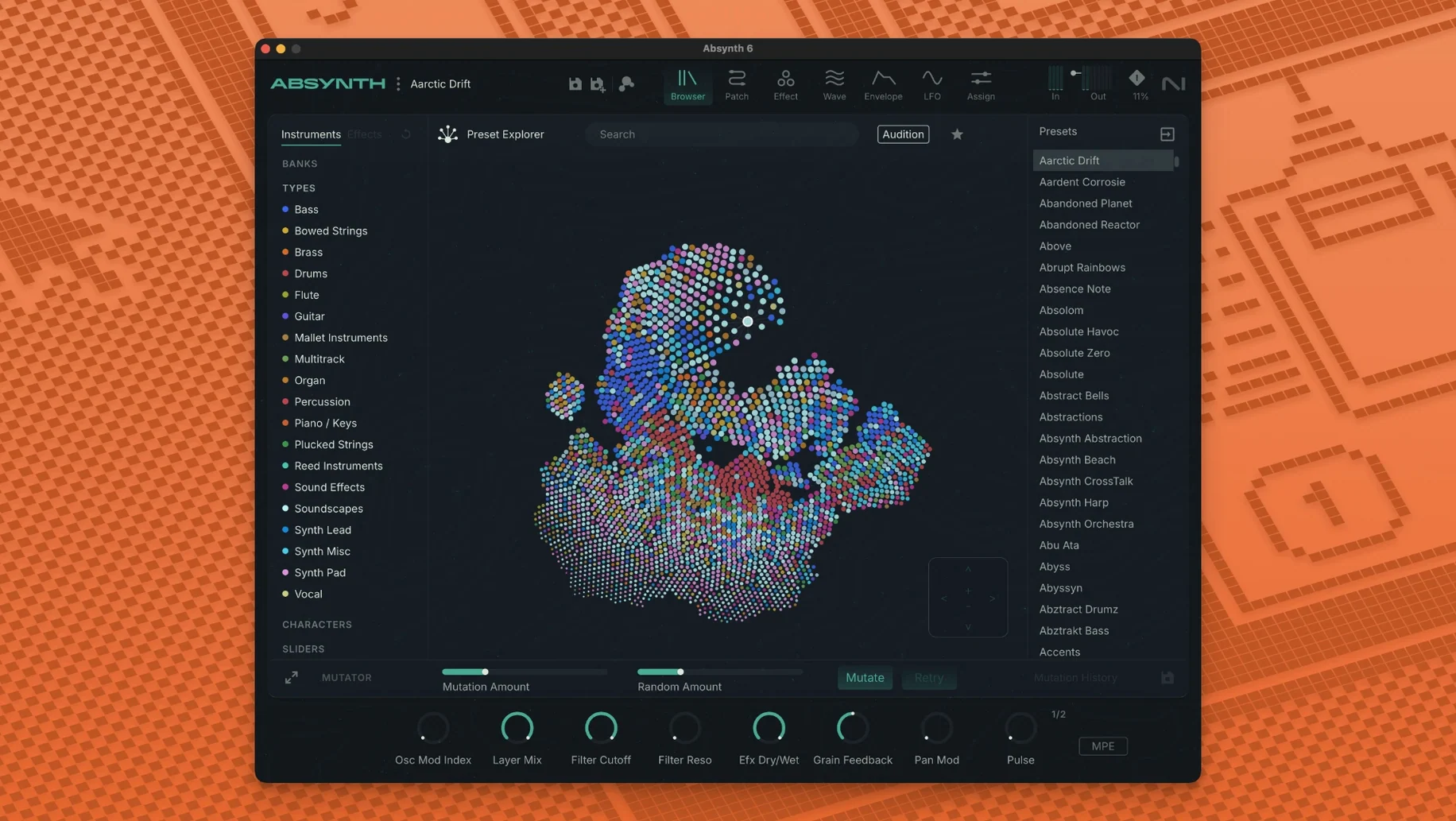
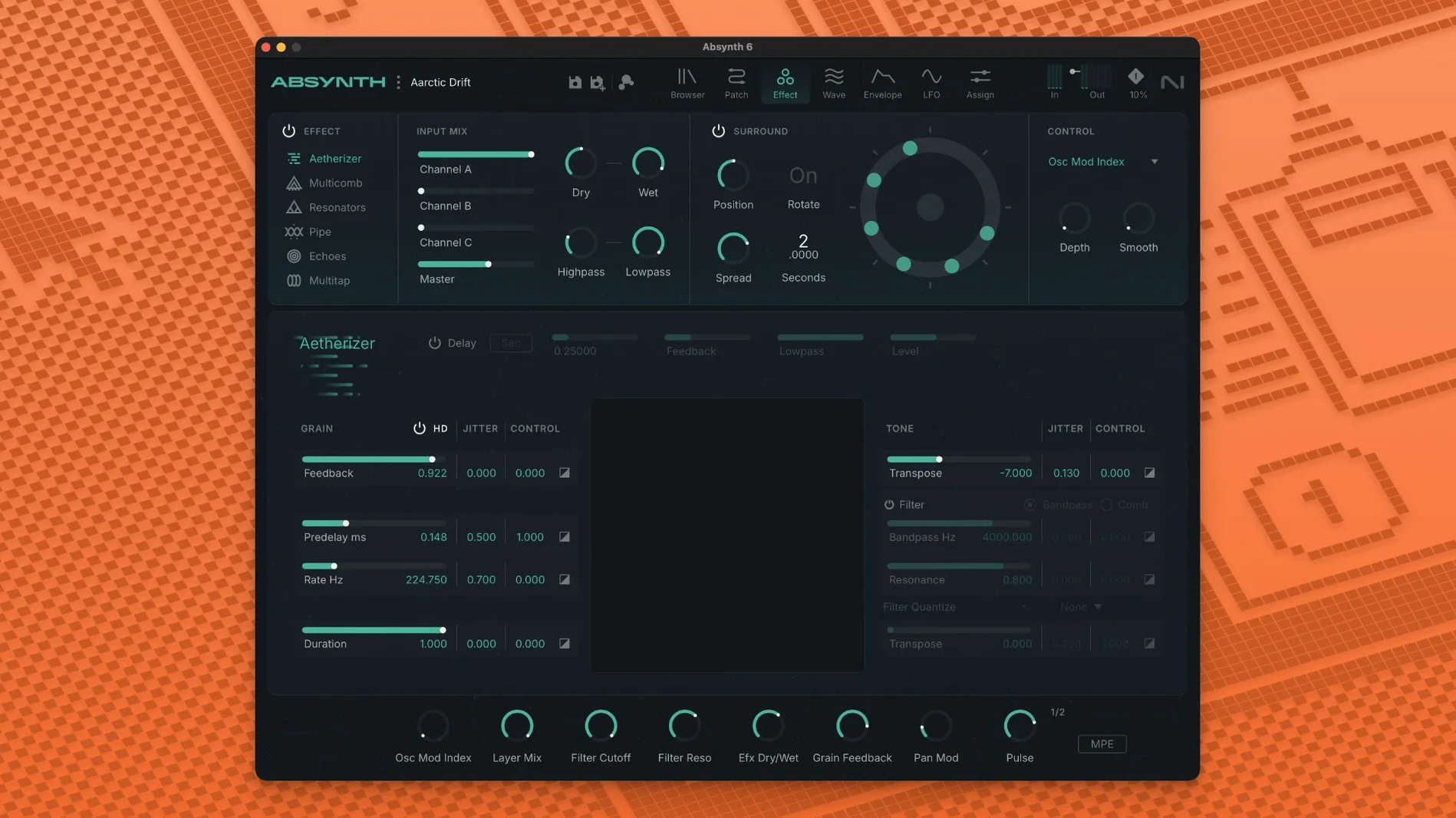
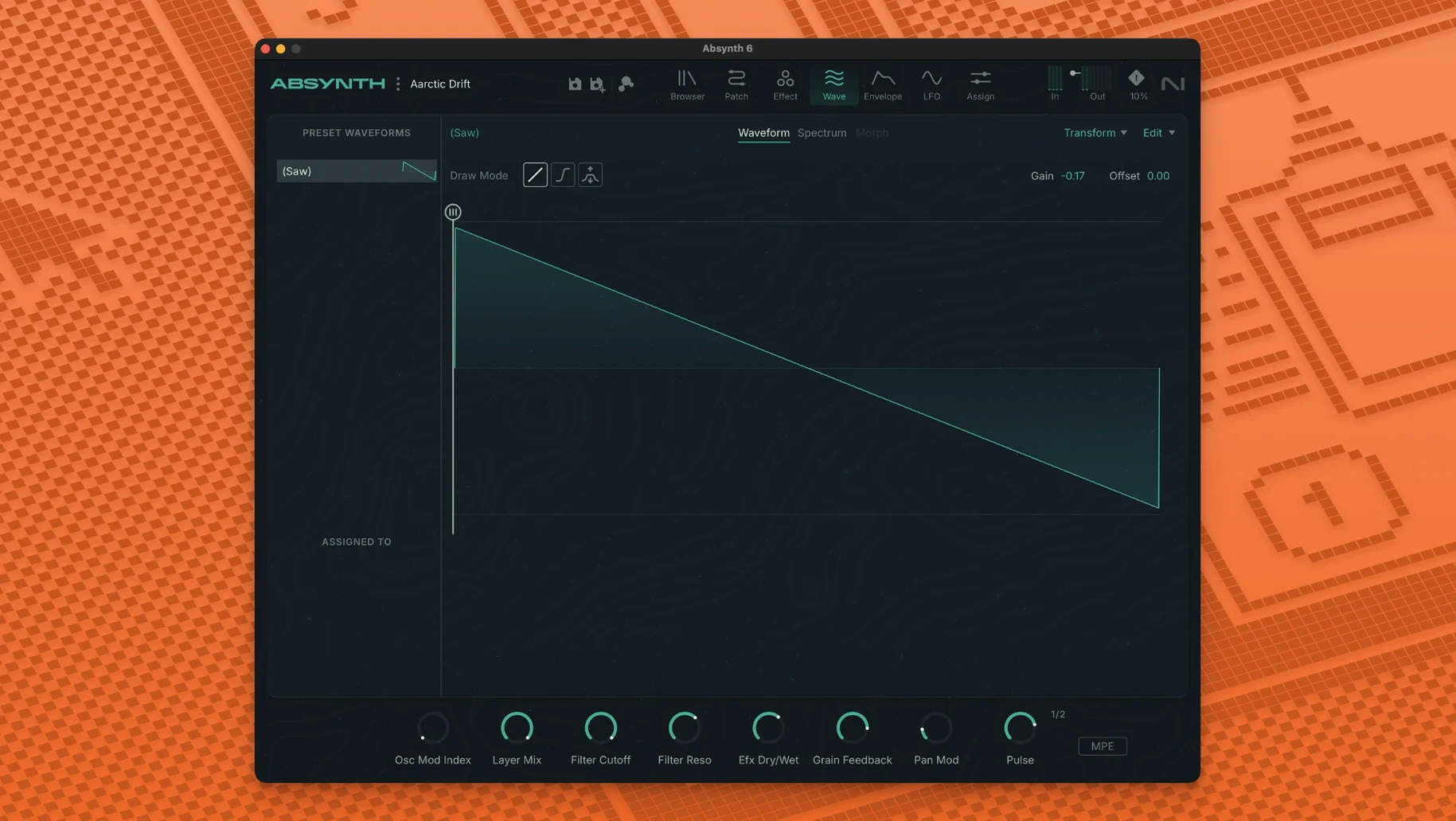
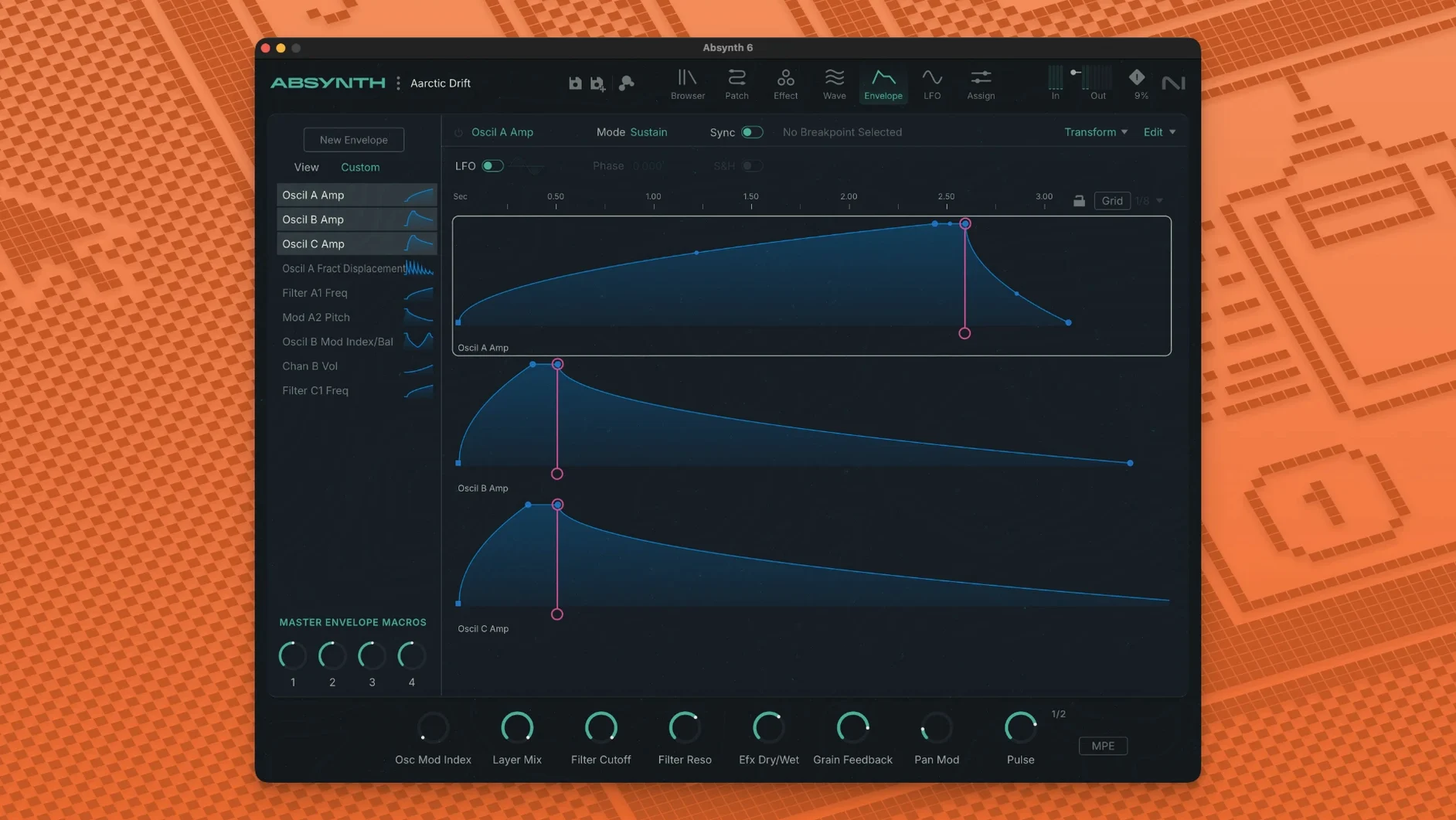
You load up Absynth and start with a field recording of rain against a window. In the oscillator section you set it to granular mode, stretching the transient of a single droplet into a glassy pad that sustains for several seconds. A second oscillator, running a wavetable from the new library, adds a metallic sheen. By the time you route both through the Aetherizer, the sound has moved somewhere between a choir and a distant thunderstorm — and you have not touched a third of the routing options.
A few things come up before someone installs it. One is whether the current version runs on a modern Mac. Absynth 6 supports Apple Silicon and Intel processors natively, requires macOS 14, and works in 64-bit VST3, AU and AAX hosts. 4 GB of RAM is the minimum, with 6 GB recommended for larger patches.
Another question is about sound character. The architecture combines four synthesis methods — subtractive, FM, wavetable and granular — in a semi-modular layout. You can use them individually or patch them together. The effect section includes the Aetherizer, Cloud Filter and Supercomb, each capable of reshaping a source beyond recognition. The Sound Mutator takes two presets and blends their traits into a third, which is useful when browsing the 250 new presets does not quite land on what you need.
People also ask about controller support. Full MPE and polyphonic aftertouch are built in, so a controller like a ROLI Seaboard or a LinnStrument can modulate pitch, timbre and amplitude per note. On the output side, the synth handles up to eight-channel surround — Quadraphonic, 5.1 and Octaphonic formats are all supported, which matters for installation work and multichannel composition.
Memory footprint for oscillators versus granular patches
On an Apple Silicon Mac, Absynth 6 loads quickly and settles into a modest memory footprint for most patches — roughly 300–500 MB for a typical multi-oscillator sound with two effects active. Granular patches with long sample buffers push that higher, sometimes reaching 1.2 GB when you stretch a stereo recording across several voices. CPU load depends on voice count and the effect chain. A four-voice pad with the Aetherizer and Cloud Filter in series sits around 12–15% on a single core. Dense unison patches with eight voices and Supercomb engaged can spike to 30%, though the engine spreads polyphony across available cores without obvious bottlenecks.
Stability has been consistent through long sessions. The plug-in recovers cleanly from host buffer-size changes in Ableton Live and Logic Pro, and we encountered no sudden silence or crackling when switching presets mid-phrase. One behaviour worth noting: loading a patch that references a missing sample does not crash the instrument. It simply silences the oscillator and marks the slot in the browser — helpful during a late-night session when you have moved a sample folder and forgotten about it.
Standalone use is not part of the package. Absynth 6 runs exclusively as a plug-in, which means resource use is always shared with a host. In a project with 30 tracks and three instances, the combined memory draw stayed under 2 GB in our testing, leaving comfortable headroom on a 16 GB machine.
Tabbed modulation routing versus Pigments’ animated signal flow
Compared with Arturia Pigments, Absynth feels less visually driven and more patch-cable in its thinking. Pigments puts modulation animation and a polished signal-flow diagram at the centre; Absynth hides much of its routing in tabbed panels and expects you to build a mental map. That makes Pigments quicker to learn, but Absynth rewards patience with stranger, less predictable results — particularly once the Sound Mutator and granular oscillator enter the picture.
Next to u-he Zebra, the difference is partly about architecture and partly about texture. Zebra’s semi-modular grid is more transparent, and its oscillators have a precise, controlled character that suits cinematic bass and leads. Absynth’s granular and wavetable engines, combined with the Aetherizer, produce a hazier, more diffuse tone. Zebra wins on CPU efficiency for complex patches; Absynth offers a wider palette of unconventional effect chains without needing external processing.
With Logic Pro’s Alchemy, the overlap is considerable — both are hybrid synths with granular, additive and spectral capabilities. Alchemy integrates more tightly with Logic’s browser and has a broader range of factory content. Absynth counters with multi-channel surround output, the Sound Mutator, and a modulation system that feels more exploratory once you move beyond the basics. Someone deep in the Logic ecosystem may reach for Alchemy first, then turn to Absynth when a sound needs stranger spatial treatment or a mutation path that Alchemy cannot replicate.
Preset search returns nothing until indexing finishes
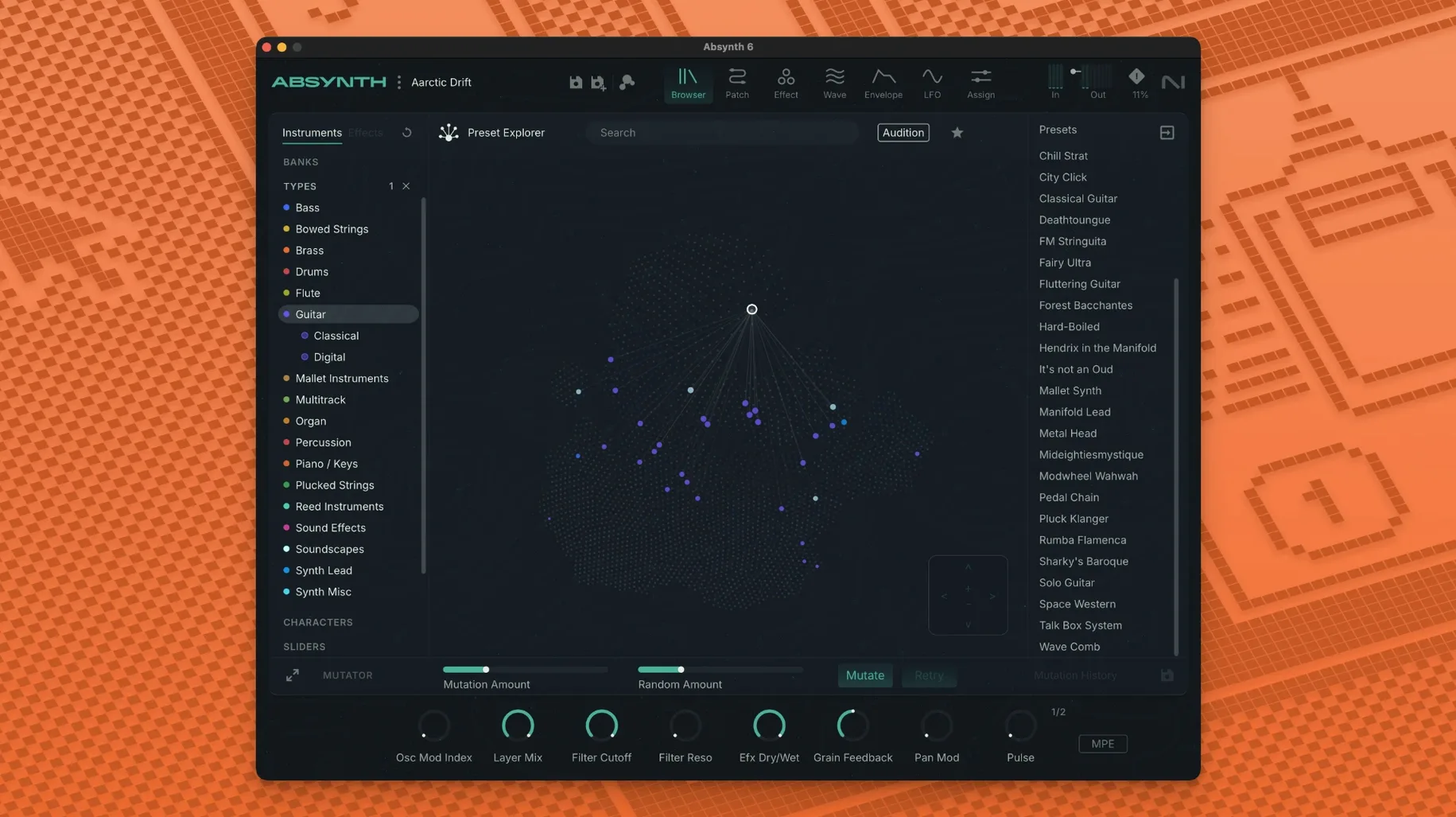
A recurring stumbling block is the preset browser search. Typing a partial word sometimes returns no results until you clear the field and re-type slowly — this appears related to the indexing delay on first launch. Letting the browser sit for 30 seconds after installation, then restarting the host, usually resolves it.
Another snag involves the granular oscillator and sample length. Dropping a file longer than 90 seconds can cause the waveform display to freeze, even though playback continues. Splitting long recordings into shorter segments before loading avoids the freeze and also makes grain-position modulation more manageable.
MPE setup trips up users who connect a controller after the plug-in is already instantiated. Absynth detects MPE at plug-in initialisation, not on the fly. The fix is simple: connect the controller first, then insert Absynth on the track. In some hosts, like Bitwig Studio, you may also need to enable MPE on the track inspector manually.
Surround output routing causes confusion in stereo-only hosts. If your host does not expose multi-channel buses, the extra outputs are simply unavailable — there is no downmix option within the plug-in. Working in a host that supports multi-channel tracks, such as Reaper or Logic Pro (with the correct track format set), is the only way to access the full output complement.
Right-click oscillator bypass and shift-drag envelope breakpoints
- Right-click oscillator bypass. Right-clicking an oscillator module header toggles it off without removing the routing. Useful for isolating one sound source during patch construction.
- Shift-drag on envelope breakpoints. Holding Shift while dragging a breakpoint in the envelope editor constrains movement to vertical or horizontal, making fine-tuning of level or timing much less fiddly.
- Double-click parameter reset. Double-clicking any knob or slider returns it to its default value — a consistent behaviour across the interface that is not mentioned in the on-screen tooltips.
- Sound Mutator blend via MIDI. The mutation amount can be assigned to a MIDI controller, letting you morph between the two source presets in real time. Assign it once in the modulation panel and it persists across preset changes.
- Browser favourites. The preset browser supports a star-rating system. Marking sounds as you audition them builds a shortlist quickly, and the rating column is sortable — a small detail that speeds up patch selection during a sound design sprint.